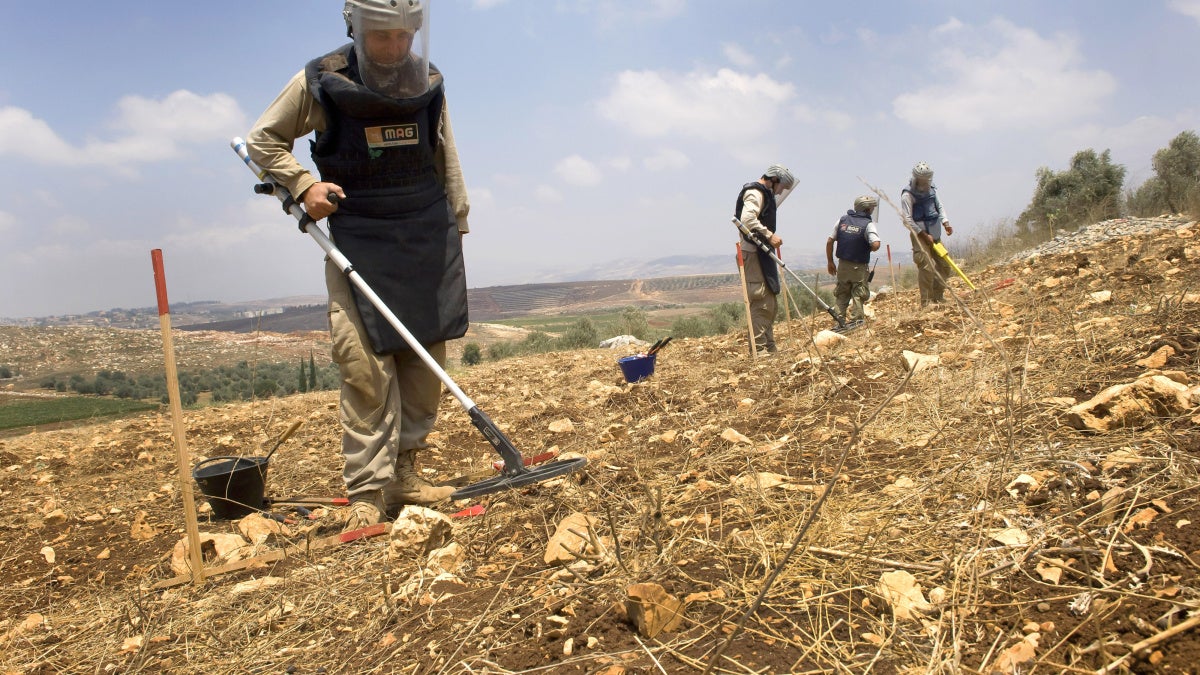
(Beirut, May 27, 2026) – Lebanon’s recent accession to the Mine Ban Treaty amid an ongoing armed conflict underscores the treaty’s vital importance for saving lives and rebuilding communities, Human Rights Watch said today. The government’s decision should motivate other countries, particularly in the Middle East and North Africa, to support the global norm against antipersonnel mines.
“Lebanon’s adoption of the Mine Ban Treaty during unrelenting fighting and destruction at home and in the region is an important step toward safeguarding civilian lives, assisting mine victims, and restoring land to its communities,” said Verity Coyle, deputy crisis, conflict and arms director at Human Rights Watch. “States that haven’t signed on should urgently follow suit.”
Antipersonnel mines kill and wound people indiscriminately. They are typically placed by hand but can also be scattered by aircraft, rockets, artillery, and drones or dispersed from specialized vehicles. Uncleared landmines remain a danger until located and destroyed. Mined land can drive displacement of civilians, hinder the delivery of humanitarian aid, and prevent agricultural activities.
The Mine Ban Treaty, which entered into force in 1999, comprehensively prohibits the use of antipersonnel mines and requires countries to destroy their stockpiles, clear mined areas, and help victims.
Lebanon is heavily contaminated with antipersonnel landmines. Despite ongoing clearance efforts that remove thousands of mines every year, by the end of 2024 at least 15.79 square kilometers of land remained contaminated with landmines and an additional 4.67 square kilometers were contaminated with cluster munitions, which effectively act as landmines. In 2023, the United Nations Interim Force in Lebanon (UNIFIL) estimated that this contamination affects at least 200,000 people in Lebanon.
Between 2015 and 2024, mines or explosive remnants of war killed at least 167 people in Lebanon.
The Lebanese government has shown interest in the Mine Ban Treaty since the early 2000s but pointed to the security situation in the country as an impediment. In December 2009, Lebanon confirmed that it “has never produced or exported antipersonnel mines.”
In January 2026, Lebanon’s Council of Ministers issued a decree approving the country’s accession to the treaty. Lebanon deposited its instrument of accession to the treaty with the United Nations in New York City on May 1, becoming the 162nd country to join. The treaty will enter into force for Lebanon on November 1, 2026.
Lebanon’s accession comes at a critical time for the treaty as five European states—Latvia, Lithuania, Estonia, Finland, and Poland—withdrew from the treaty in 2025, and Ukraine has attempted to suspend its obligations, all citing security concerns as the primary reason for their decision.
Lebanon is now required to submit an initial transparency report to the UN and begin to implement the provisions of the Mine Ban Treaty in territory under its jurisdiction or control under all circumstances.
Other states should follow Lebanon’s example and join the treaty immediately. Countries in the Middle East and North Africa region that remain outside the Mine Ban Treaty include Bahrain, Egypt, Iran, Israel, Libya, Morocco, Saudi Arabia, Syria, and the United Arab Emirates.
“Lebanon’s joining the Mine Ban Treaty strengthens global opposition to these horrific weapons and should encourage other states to do so,” Coyle said. “The fact that Lebanon made this legal commitment in the midst of a crisis should remind other countries why international treaties protecting civilians are so critical.”
Human Rights Watch is a founding member of the International Campaign to Ban Landmines (ICBL), chaired the US Campaign to Ban Landmines, and served as ban policy editor for Landmine and Cluster Munition Monitor. The ICBL received the 1997 Nobel Peace Prize, together with its coordinator, Jody Williams, for its efforts to bring about the Mine Ban Treaty and for its contributions to new international diplomacy based on humanitarian imperatives.