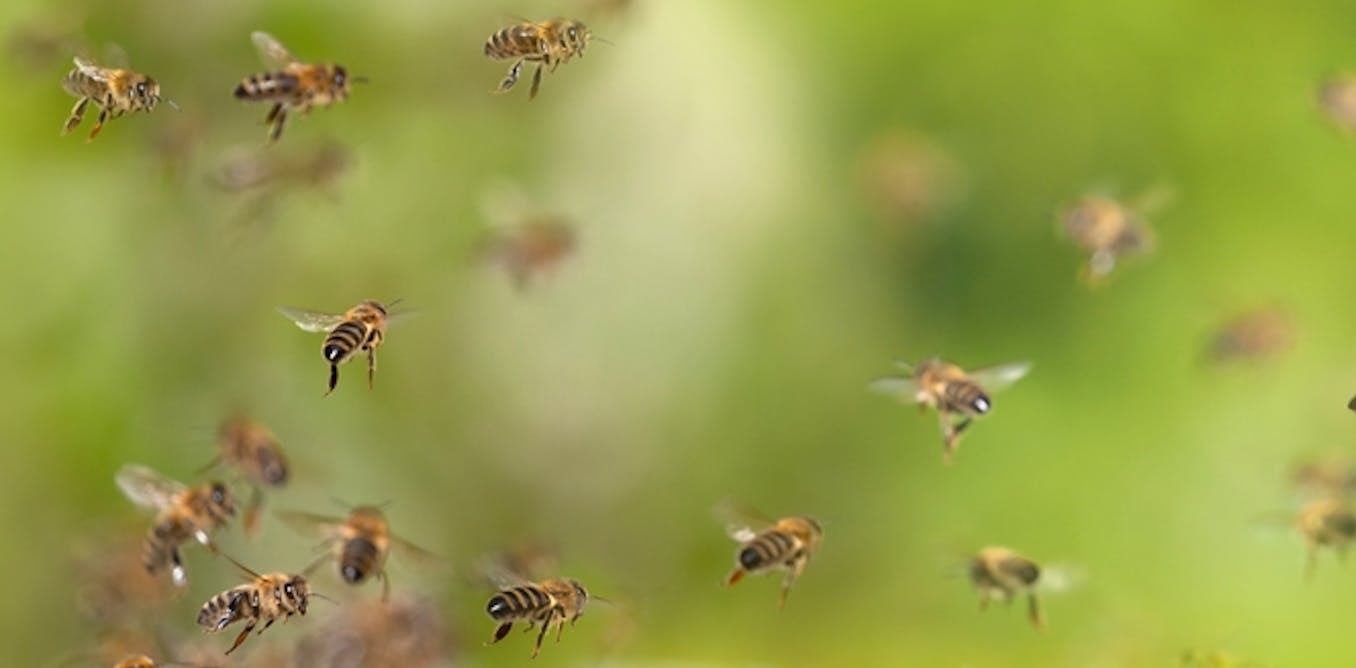
The importance of bees for pollinating wild plants and crops is well known. If we lose the bees, we lose our food. But this is only part of the picture. Bees also support a hidden network of other species, sometimes as mutual partners, sometimes as prey, sometimes as other unwilling victims.
Many organisms depend on bees for survival, and many of these interactions are not mutually supportive. Some predators focus on bees, for example bee wolves (Philanthus triangulum), capture bees to feed their young in their underground nests.
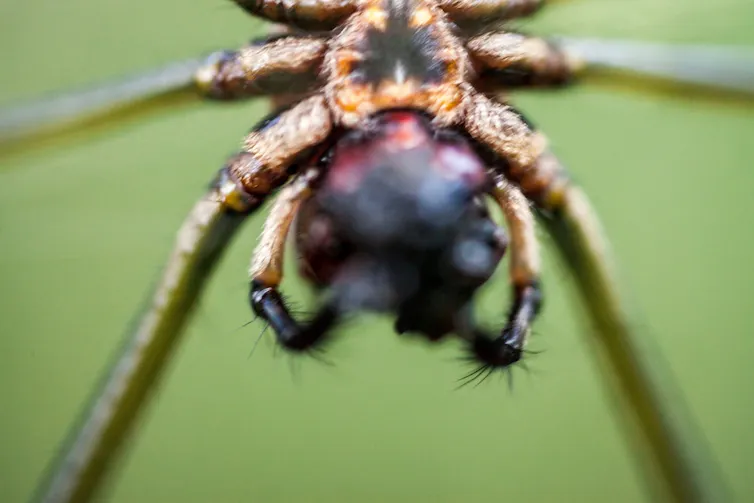
Crab spiders, also known as the white death spider, are often found camouflaged on the top of flowers. They wait for bees to sip on some nectar and then the spider consumes the bee, and afterwards vomits the corpse back up.
It’s not just insects, vertebrates depend on bees too. Birds such as bee‑eaters and great tits, as well as some species of bat consume bees as part of their diet, while badgers and foxes often raid nests for larvae and honey. And, of course, humans have been eating honey from before there were written records.
Playing host to unwelcome guests
Around 40% of animals are actually parasites and bees support a wide range of these species. The wingless fly Braula coeca, sometimes referred to as the bee louse, lives on honey bees, feeding on their secretions. Though small, these parasites are a constant presence in some colonies.
EUIP/Shutterstock
Another parasite, Sphaerularia bombi, the nematode (a type of worm-like creature), enters bumblebee queens during hibernation. Once inside they inflate, filling much of the queen’s body. When she emerges in the spring, this queen has been neutered by the parasite and is no longer able to find a new family. She instead just acts as a vehicle to spread the parasite to new sites.
Some bees need other bees to help them survive. Cuckoo bees infiltrate the nests of bumblebees. After they gain access they suppress the bumble bee queen and force her workers to raise their young.
Invading the lives of bees
Sometimes parasitic interactions go one step further and ultimately kill the bee by spending part of their lifecycle within their host. Strepsiptera are an unusual insect, which most people may not have heard of. Stylops are one genus of Strepsiptera which live in the abdomens of bees, visible only by a small protrusion in the abdomen. But when it is time for Stylops to mate they explode from the abdomen of their bee host, killing it.
Bee flies definitely deserves a mention, as they bear a striking resemblance to bees. In the UK, species such as Bombylius major dance around flowers with their fuzzy, bee‑like bodies. While the adults are harmless and actually serve a role as pollinators themselves, their larvae are parasitoids of solitary mining bees. Parasitoids are defined as those that live on (or in) their host eventually killing it, a subset of parasites. The females flick their eggs into the entrances of bee nests and when they hatch, the larva consumes bee eggs or young larvae before feeding on the pollen stores.
Using bees to hitch a ride
Some species just use bees for transport. Mites such as Chaetodactylus attach themselves to solitary bees in order to travel between nests. Their larvae however, are less benign. They greedily consume the pollen stores of nests, occasionally eating eggs.
Perhaps even weirder however are the trigulins (or larvae) of blister beetles. These often cluster around flowerheads. They wait for bees, only to then climb on board for a free ride – using them as a free taxi to a nest where they feed on its contents with a particular fondness for bee eggs.
Pseudoscorpions are a distant relative of scorpions. They bear a striking resemblance to true scorpions, but these instead of carrying a sting in their tail, use the bee for a free ride. Hanging on to the bees with their pincers they use the bees as a taxi, but in their case just as a way to save energy on long-distance travel.
In the end, bees – whether they are solitary bees, mining bees, honey bees or bumble bees – are far more than pollinators. They support a much wider ecosystem. Countless other organisms rely on bees as hosts, prey, transport, or providers of food and shelter every day. Without bees we would not only lose those plants they pollinate but also those animals that need the bees to feed them and help them reproduce.

Alex Dittrich does not work for, consult, own shares in or receive funding from any company or organisation that would benefit from this article, and has disclosed no relevant affiliations beyond their academic appointment.