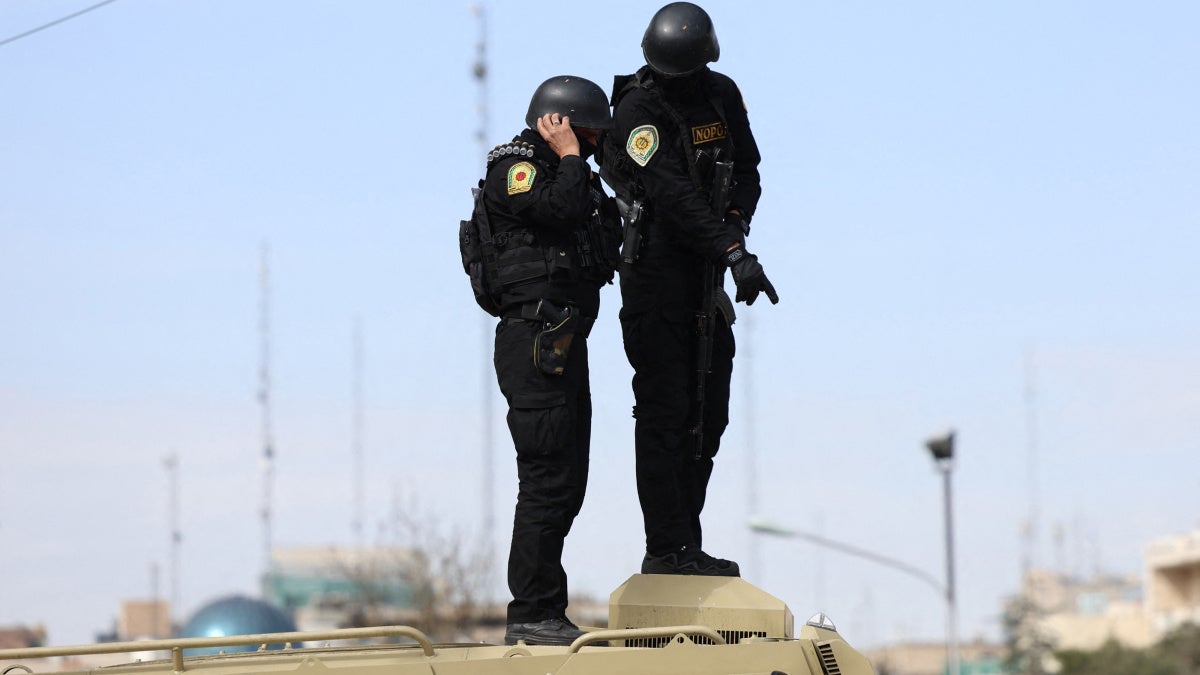
(Beirut) – Iran’s Islamic Revolutionary Guard Corps (IRGC) is conducting a campaign to recruit children as young as 12 to volunteer to become “homeland defending combatants,” Human Rights Watch said today. The military recruitment and use of children is a grave violation of children’s rights and a war crime when the children are under 15.
On March 26, 2026, an official from the IRGC’s 27th Mohammad Rasulullah Division in Tehran said that a campaign to enlist civilians, called “Homeland Defending Combatants for Iran,” had set the minimum age at 12. Amid thousands of attacks by the United States and Israel across the country, children at military facilities would be at serious risk of death and injury. Iranian officials should revoke the campaign and prohibit all military and paramilitary forces in Iran from enlisting children under 18.
“There is no excuse for a military recruitment drive that targets children to sign up, much less 12-year-olds,” said Bill Van Esveld, associate children’s rights director at Human Rights Watch. “What this boils down to is that Iranian authorities are apparently willing to risk children’s lives for some extra manpower.”
The campaign aims to attract civilians to provide cooking services and medical care, distribute items, and deal with damaged homes, as well as for security activities such as staffing checkpoints, operational patrols, intelligence patrols, and vehicle convoys, said Rahim Nadali, an IRGC official, in an interview with Iran’s Defa Press News Agency. The advertising poster for the recruitment drive, published by the news agency, also lists these activities and features two children, a boy and a girl, alongside two adults, including a man in a military uniform.
In a televised interview, Nadali said that “[in relation to] intelligence and operational patrols, teenagers and the youth repeatedly have come and said that they want to take part in them. For the Basij checkpoints that you see across cities now, we have had many young people and teenagers demanding to be present in them. Given the ages that were making demands, we have set the [minimum] age at 12. Meaning now there are kids of 12 and 13 who want to be present in this space.”
Applicants can register at Tehran mosques that house Basij bases, Nadali and the recruitment poster said. The Basij force is under the IRGC’s command.
Over the past month, the United States and Israel have reportedly carried out what they say are tens of thousands of airstrikes against numerous Basij and IRGC facilities and multiple Basij checkpoints in Tehran, killing and wounding personnel.
Children in Iran have already been subject to unlawful attacks. Human Rights Watch determined that an unlawful attack on a primary school in Minab, Iran on February 28 that killed dozens of schoolchildren and other civilians should be investigated as a war crime. According to a preliminary US military report, the United States was responsible for the attack. Human Rights Watch has said that Congress should hold dedicated hearings on the US military’s targeting practices.
Iran has for years enlisted children under 18 in the Basij force, and the IRGC sent Afghan immigrant children living in Iran as child soldiers to support the Assad government during the civil war in Syria. Human Rights Watch documented that boys as young as 14 were killed in combat. According to Iranian officials, in the 1980s, authorities recruited hundreds of thousands of children to fight in the Iran-Iraq war, with tens of thousands killed.
The office of the United Nations Special Representative on Children and Armed Conflict states that “no matter their role, [children] associated with parties to conflict are exposed to acute levels of violence.”
Iran’s laws explicitly provide for the military recruitment of children as young as 15.
Under the “bylaws and regulations of the Islamic Revolutionary Guard Corps,” individuals must be at least 16 years old to be eligible for employment by the IRGC, including as permanent staff, contractual staff, and special Basiji personnel. Special Basijis are honorary IRGC guards who “possess the qualifications of an [official] guard and… commit to being available full-time to the IRGC when needed.” However, under article 94, children ages 15 and above can qualify as an “active” member, who can “collaborate with the IRGC in carrying out assigned missions” after completing training courses.
In its first report to the UN Committee on the Rights of Child, Iran stated that the country’s laws provide that the minimum age “for the armed forces for the purpose of receiving military training is 16 and the minimum age of employment for the Police Forces is 17.”
The UN Security Council has “strongly condemned” child recruitment and established a reporting system, led by the secretary-general, that considers it a “grave violation” against children. The Convention on the Rights of the Child prohibits recruitment of children under 15. An Optional Protocol to the Convention, which Iran signed but has not ratified, provides that 18 is the minimum age for direct participation in hostilities. Iran is bound by customary international law, which provides that recruitment of children under age 15 is a war crime.
“The officials involved in this reprehensible policy are putting children at risk of serious and irreversible harm and themselves at risk of criminal liability,” Van Esveld said. “Senior leaders who fail to put a stop to this can make no claim to care for Iran’s children.”