KAMPALA — Russian President Vladimir Putin has become the first major global power to formally congratulate Uganda’s President Yoweri Museveni on his re-election to a seventh term, a victory that extends his tenure to 45 years. In a message delivered Friday, January 23, 2026, Putin reaffirmed Moscow’s commitment to “mutually beneficial bilateral cooperation,” signaling Russia’s intent to deepen its strategic foothold in East Africa through trade, defense, and energy partnerships.
The endorsement comes at a volatile moment for Uganda. While government supporters celebrated a “landslide” victory, the political atmosphere in Kampala remains heavy with allegations of systemic fraud, violent repression, and a digital blackout.
The Final Tally: A Foregone Conclusion?
According to the official results released by the Electoral Commission on Saturday, January 17, Museveni, 81, secured 71.65% of the vote. His primary challenger, the 43-year-old pop-star-turned-politician Bobi Wine (Robert Kyagulanyi Ssentamu), trailed with 24.72%.
| Candidate | Party | Votes | Share (%) |
| Yoweri Museveni | National Resistance Movement (NRM) | 7,946,772 | 71.65% |
| Bobi Wine | National Unity Platform (NUP) | 2,741,238 | 24.72% |
| Others (6 candidates) | Various | 402,838 | 3.63% |
“Calculated Repression”: The Opposition’s Defiance
Bobi Wine has categorically rejected the results, describing the election as a “fabricated sham.” Speaking from a secure location after reportedly escaping a military raid on his home, Wine alleged widespread ballot stuffing and the abduction of over 2,000 opposition polling agents.
“The results do not represent what came from the polling stations,” Wine stated, citing videos of security forces allegedly marking ballots in favor of the incumbent. He has urged his supporters to invoke their constitutional right to peaceful protest, though he declined to challenge the results in court, claiming the judiciary is “not independent.”
The Human Cost of “Stability”
The post-election landscape has been marred by a significant spike in state-led violence. Military chief Muhoozi Kainerugaba—President Museveni’s son and widely expected successor—confirmed on Friday that authorities had killed 30 “terrorists” (referring to NUP supporters) and detained thousands following the vote.
- Internet Blackout: A nationwide digital shutdown, imposed two days before the poll, was only partially lifted late this week, which critics say provided a “shroud of darkness” for electoral irregularities.
- Youth Frustration: With 78% of the population under age 35, many young Ugandans expressed despair over the results. Despite government claims of “economic growth,” youth unemployment remains at staggering levels, with critics arguing that wealth is concentrated among a “selected few” close to the ruling NRM.
A Geopolitical Pivot
While the European Union and the African Union issued cautious statements “taking note” of the results while highlighting concerns over the lack of a level playing field, Putin’s swift embrace of Museveni underscores a shifting geopolitical alignment.
Russia’s focus on Uganda is part of a broader 2026–2029 “Action Plan” to revitalize partnerships across Africa, focusing on defense hardware and nuclear energy cooperation. For Museveni, Moscow’s backing provides a critical diplomatic shield against Western pressure regarding human rights and democratic backsliding.
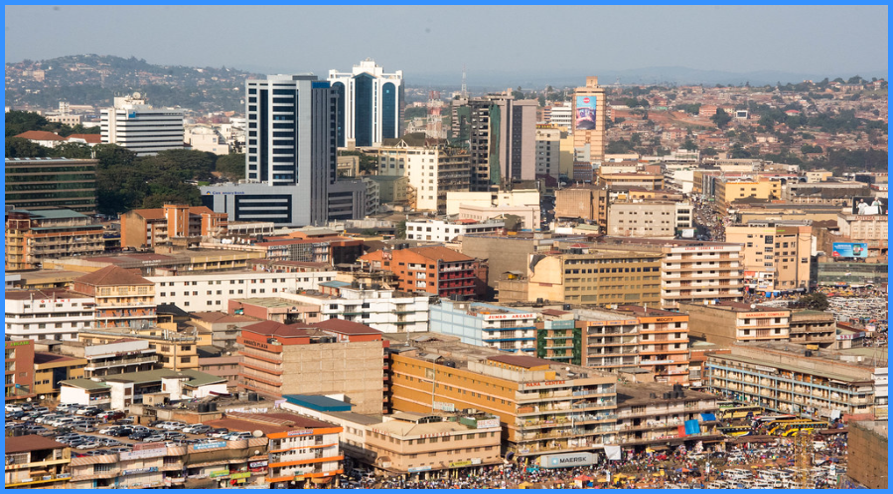
Uganda Capital City, Kampala Skyline. Picture by Andrew Regan