A year into Donald Trump’s second presidency, he is pressing ahead with a volatile agenda that tests the limits of the international order.
Europe, by contrast, looks disorganised in the face of the threats Trump is making to annex Greenland and strategically hesitant overall. Rather than setting out a coherent approach, the response risks splintering into reactive moves shaped by domestic constraints.
If this pattern continues, the fallout could be far more serious than many seem to grasp – especially as Trump appears willing to brush aside international law and go after European leaders personally whenever it serves his political brand.
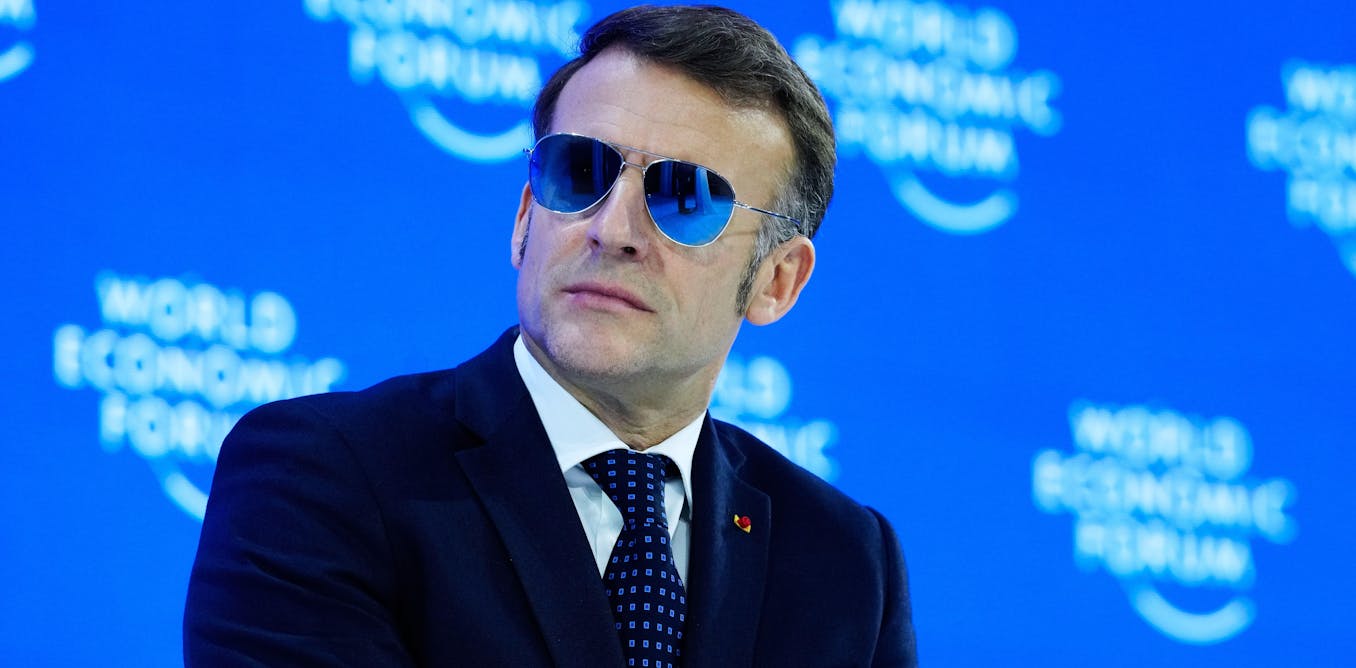
European leaders are sending markedly inconsistent signals. French president Emmanuel Macron has been more assertive than most. He has framed Trump’s posture as a “new colonial approach”, rejecting what he depicts as politics conducted through intimidation rather than rules.
Perhaps his deep unpopularity at home helps explain his more decisive stance against Trump – an attempt to project himself as a tougher, more explicitly pro-European leader.
By contrast, German chancellor Friedrich Merz has prioritised de-escalation. He warns against a spiral of retaliation, while still signalling that Europe could respond if coercion intensifies.
Like Macron, Merz has had a difficult year since winning the 2025 federal election. But his cautious style suggests he is inclined to test the waters and avoid escalating tensions with the US. After all, most of his policy moves over the past 12 months have done little to lift his popularity.
Italian prime minister Giorgia Meloni, meanwhile, has positioned herself as a potential mediator, seeking to manage the confrontation rather than confront it head-on. Unlike Macron and Merz, she remains popular in Italy, and her voters appear to approve of her approach to Trump and the US so far. Her recent comments suggest she intends to stay the course.
That lack of coherence is compounded by the strategic hedging of Trump-aligned leaders inside the EU. Viktor Orbán of Hungary and Robert Fico of Slovakia have avoided explicit pushback on threats to Denmark’s sovereignty, focusing instead on their bilateral channels with Trump and other agenda items. This behaviour risks weakening collective deterrence by signalling disunity at the very moment unity is most consequential.
Different dynamics
A similar pattern was clearly visible after the US abducted Nicolás Maduro from Venezuela. While EU and UK responses emphasised process and dialogue, they avoided taking a stance on the legality of those actions – even as legal scholars and public institutions raised serious concerns about compliance with international law.
Europe has a narrowing window to treat these episodes as a single strategic problem. Downplaying the threats coming out of the White House as bluster does not reduce the risk – it in fact lowers the political cost of escalation on the US’s part and makes an eventual attempt at annexation easier to present as “inevitable”.
If threats of territorial revisionism are met with hedging by Europe and talk of “monitoring”, they begin to look like another negotiating style rather than what they are – a direct challenge to the post-war European security order.
EPA/Aaron Schwartz
Trump has never disguised his contempt for the contemporary political mainstream. He has repeatedly lent political oxygen to far-right projects across Europe, treating them as ideological kin rather than as democratic outliers. Europe therefore needs to face a blunt reality: this crisis is politically damaging whatever course leaders choose. More power for Trump is more power for the far right.
Hostility towards Trump is widespread among the general public in Europe. This should not be treated as background noise. It is a political signal that voters expect clarity. When that clarity does not materialise, the message received by the public is that the political system is either unable or unwilling to defend basic principles and security.
In that context, institutional credibility erodes fast, and the far right gains. If the mainstream appears weak, evasive and unserious in the face of the gravest security risk Europe has confronted since the second world war, it appears illegitimate.
Very few far right figures (with the exception of the French National Rally’s Jordan Bardella) have said anything about the current situation. Silence is not necessarily a weakness here, because it often looks strategic.
Trump wants allies, and much of the European far right also wants Washington’s blessing. Yet this creates an awkward tension: when a US president openly threatens European territory, the far right’s usual claims about the primacy of sovereignty could be thrown off balance.
The direct approach
One obvious place for the centre to look is to the left – not for comfort, but for political clarity. Across Europe, many leftwing parties have responded to Trump’s imperialist posture in direct, unambiguous terms.
In the UK, Green party leader Zack Polanski has called for the removal of US forces from British bases. In Germany, Die Linke has argued for European unity and resistance in the face of Trump’s threats. In France, senior figures in La France Insoumise have gone further, openly raising Nato withdrawal in response to US policy.
The point is not that every one of these positions is a blueprint. It is that responses exist – credible, legible, and politically coherent – for a continent facing an escalating threat, including the prospect of coercion against Greenland.
While the centre fragments, parts of the left have been willing to name what is happening and set out lines of action. The centre should pay attention – and catch up, fast.