Look down at the rainforest floor. Rotting flowers shift under the assault of tiny petal-eating beetles. Vividly coloured fungi pop up everywhere like the strange sculptures of a madly productive ceramicist.
Look in front of you and heliconias and calatheas, tropical plants familiar from garden centres and greenhouses, vie for the attention of hummingbirds with scarlet and orange flowers.
Look up and the distant canopy offers a full spectrum of shades of green, along with clusters of flowers and fruits in a bewildering range of shades, shapes and sizes.
You’d be excused from thinking that life in a tropical forest is easy. A lazy arm movement being all that’s needed to secure the next mouthful of food. But it’s not like that at all.
Life in the rainforest demands extraordinary adaptations.
Which is why I found myself stepping out of a small canoe on the Tapajós
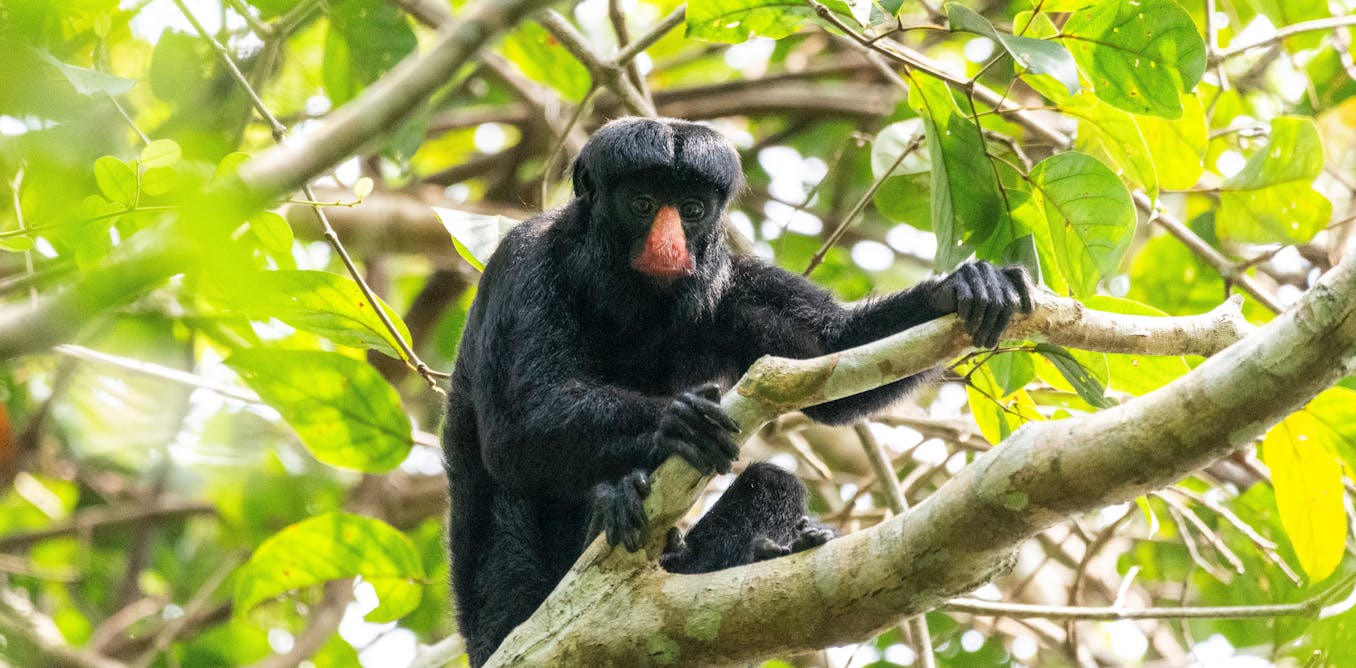
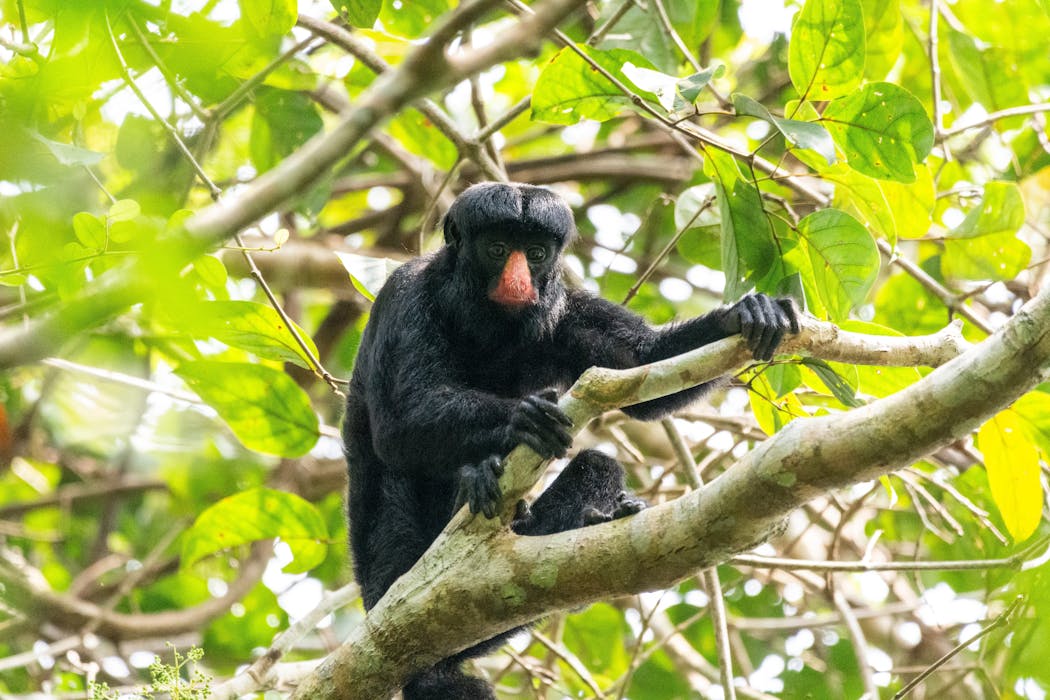
River in Brazil’s central Amazon to collect the remnants of the most recent meal of the endangered red-nosed cuxiu monkey (Chiropotes albinasus) for my recent study.
They are like no other monkey on Earth. Many species have ecological parallels on other continents, often with very similar physical and behavioural adaptations. For example, spider monkeys and gibbons, chimpanzees and capuchin monkeys. But cuxius, and their close relatives the uacaris and sakis, are a uniquely South American phenomenon.
Cuxius are cat-sized animals, with canines bigger than human teeth, even though their skull is the size of an orange. Although other primates have massive canines too (think baboons, mandrills or chimps) these are for display. Those of the cuxiu are the real deal; designed for cracking open hard, unripe fruits to get at the equally unripe and hard seeds. They eat a range of fruits that include relatives of the Brazil nut, acacia tree and oleander.
Humans would need a hammer to crack open this kind of fruit. But cuxius and their near relations bite them open. Powered by massive muscles, the jaws can deliver a bite which, if scaled for size, is equal to that of a jaguar. They eat hundreds of rock-hard fruits a week, tens of thousands over their ten-year life span.
So, I wanted to know: how do they avoid cracking their teeth along with the nuts? We know their skulls are evolved to disperse the shock of a bite. But scientists have long been mystified by how the cuxiu avoids breaking its teeth through the sheer repetitive strain.
My findings revealed that cuxius are a lot smarter and more subtle than anyone thought.
Pick up a walnut and you’ll notice a thin line running around the hard shell. This is the suture, and it’s where the shell would naturally break open to free the seed when it ripens. It’s also a lot less resistant to puncture than the rest of the fruit. Fruits with sutures dominate the diet of the red-nosed cuxiu, so I wondered if this could be the key to the cuxiu’s success.
Measurements of the force needed for a copy of a cuxiu canine to penetrate fruit outer husks showed this was the case. It took up to 70% less force to go in at the suture than elsewhere on the fruits the cuxiu ate.
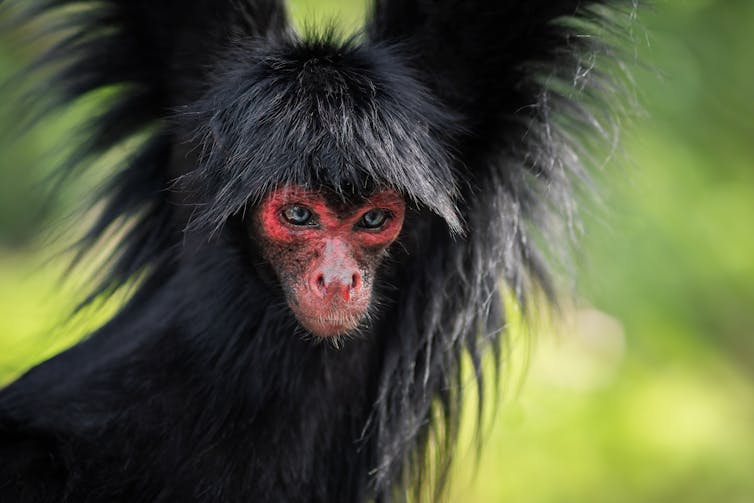
Diego Grandi/Shutterstock
My examination of skulls held in London’s Natural History Museum showed canine breakages were no more common in cuxius than in capuchins (which use either their molars or stone tools to break hard fruits) or ateline monkeys (which eat either soft pulpy fruits or leaves). Avoiding dental damage is smart – with no dentists in the forest a split tooth is a quick path to a slow death by starvation. And it allows the cuxius and their relatives to access unripe seeds, a food source few other animals can exploit.
This mirrors tactics used by carnivores like big cats, who bite prey at vulnerable spots to avoid breaking their teeth.
Then there’s the fact that every animal in the rainforest needs to be its own doctor, physiotherapist and fitness coach. With no first aid stations for bitten, twisted or shocked bodies, it’s best to avoid things going wrong in the first place. This is also true for actions that, through sheer repetition, could cause breakage through stress.
Survival in the rainforest depends on vigilance, cunning survival strategies and Olympian levels of fitness. An animal’s survival depends not only on knowing what to eat but how to eat it. Seconds count when a bite too many can mean missing the one key glance skywards that stops you becoming someone else’s breakfast.
Living in the top of the canopy of either rainforest or flooded forest, moving huge distances and doing so very fast, makes cuxius a challenge to observe. I first became interested in cuxius and uacaris because they are hard to study and, as a result, were so little known. But, soon after I started working with them, I realised cuxius and uacaris are like extreme sports athletes, pushing the boundary of what is possible in a monkey.
And they aren’t the only ones.
Swinging and hanging between the trees, the life of a spider monkey is like a perpetual parallel bar performance, not for a few brief minutes, after months of rigourous training as in humans, but all day, every day. No gold medal and long retirement, just surviving till dusk and starting again at dawn.
Additionally, while not exactly Olympian, the energy howler monkeys use during their daily calling bouts is similar to that of a mid-aria opera singer. Except that the monkeys must perform twice a day for a lifetime.
Sadly, animals’ Olympian abilities are no match for humans, whose use of tools is the equivalent of competitors using steroids or robotic enhancements. And, since it is clear that humans are not as smart as we are skilled, rainforest loss continues at a pace that even evolution – formerly the world’s best trainer – cannot have prepared them for.

Adrian Barnett does not work for, consult, own shares in or receive funding from any company or organisation that would benefit from this article, and has disclosed no relevant affiliations beyond their academic appointment.