2025 HARPER PRIZE SHORTLIST: For the next two weeks, we are featuring the articles shortlisted for the 2025 Harper Prize. The Harper Prize is an annual award for the best early career research paper published in Journal of Ecology. Xuening Zhang’s ‘Pollinator facilitation between florally contrasting congeners scales up to regional co-occurrence patterns‘ is one of those shortlisted for the award.
About the paper:
What is your shortlisted paper about, and what are you seeking to answer with your research?
While facilitative interactions have been gradually shifting our understanding of local community ecology, a perspective that has been historically dominated by competition and predation, little is known about the potential broad scale impact of facilitative interactions across space and time on species co-distributions. My paper took advantage of a locally abundant congener pair of plants, Bidens frondosa and B. cernua (Asteraceae), to test if facilitation helped predict their co-occurrences across space. Bidens frondosa is a weedy, visually inconspicuous species that has evolutionarily lost their petal-like ray florets, the main visual display organ in Asteraceae. B. cernua is a closely related congener with conspicuous ray floret displays. We first established that co-occurrence with B. cernua increased pollinator visitation and viable seed set of B. frondosa both across natural populations and in controlled common garden experiments. We then found, surprisingly, that this strong facilitation was associated with much more frequent co-occurrence between these two species than predicted by chance. Furthermore, at the genus level, B. frondosa-like Bidens spp. that have also evolutionarily lost their ray florets, co-occur more frequently with B. cernua-like species with conspicuous ray floret displays. This aggregative co-distributions between closely related species of contrasting floral forms was best explained by facilitation, and not other alternative hypotheses, suggesting that indirect plant-plant interactions can be a powerful driver of large-scale species distributions.
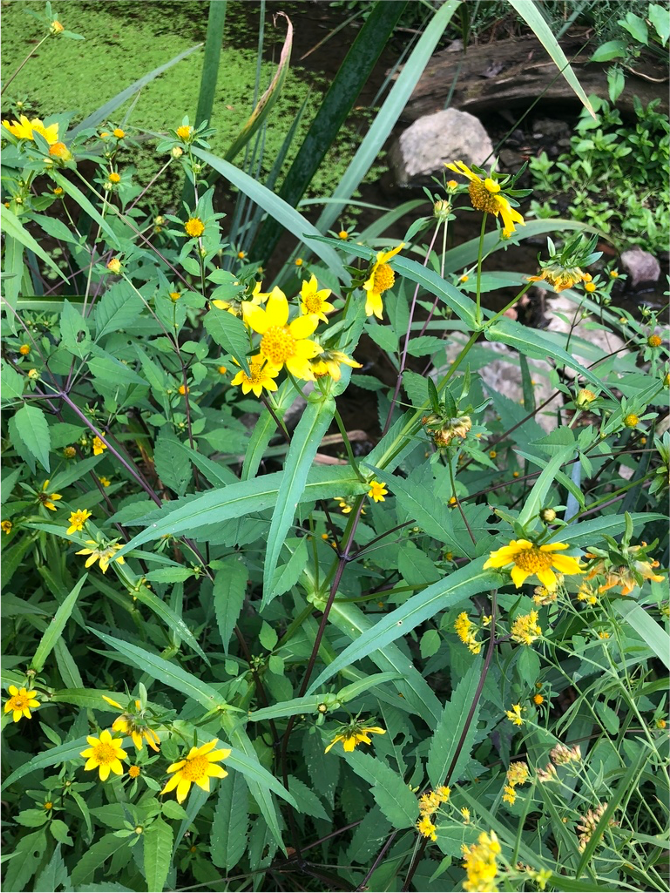
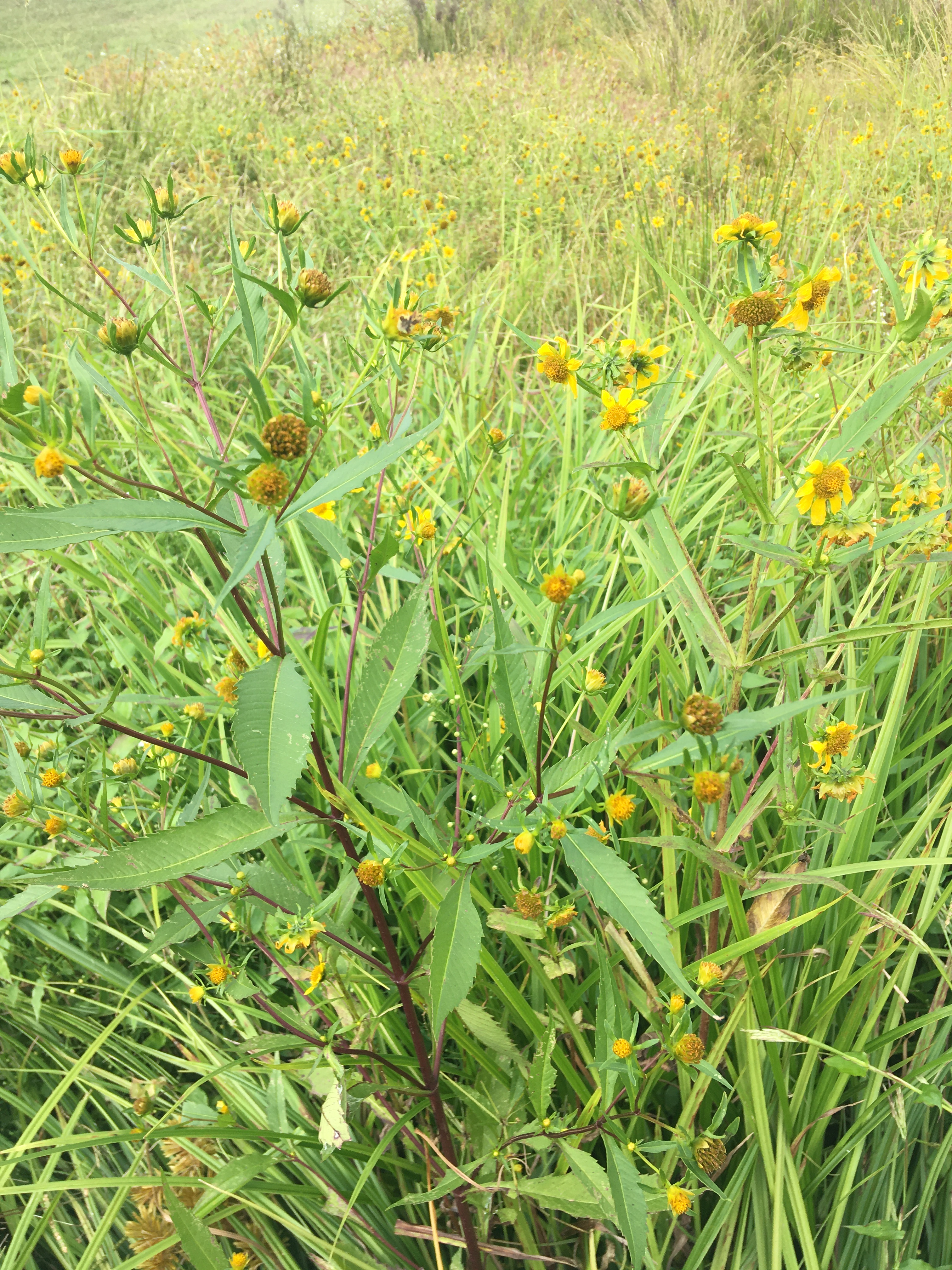
Examples of two mixed communities of co- occurring B. frondosa and B. cernua included in the study (Credit: X.Zhang).
Were you surprised by anything when working on it? Did you have any challenges to overcome?
In fact, the main surprise came from our creative solution to the main challenge of our project. To test if facilitation, or any indirect ecological interactions, impacted species co-distributions, we knew that a main alternative hypothesis that we need to test was if shared habitat preferences also drove species aggregation. We were unsatisfied with the tools we had or the methods the field have employed should we want to measure the nebulous “niche” of our two focal species. So, rather than testing this alternative hypothesis empirically using imperfect data, we tested it by reasoning from first principles and laying out all its predictions. We realized that shared habitat preferences would predict that if species A shared the same habitat as B, and B as C, then by the transitive nature of equality, A shared the same habitat as -and thus co-occur frequently with- C. In our system, we found that this was not true. Instead, pollinator facilitation, likely via the magnet flower effect, was the mechanism that explain all the observed species co-distributions at the genus level. In contrast, the other alternative hypotheses only explained some of the observations, while contradicted others.
Through this project, I also learned about the complicated and delicate status of land ownership, and how as ecologists we should access them. The transects that I surveyed comprised of land that were patchily owned by various private and public entities, and the process of working with them has been a salient lesson in land ownership and stewardship.
What is the next step in this field going to be?
Facilitation, or positive mutualistic interactions more broadly, are increasingly being recognized as important ecological processes shaping community dynamics (Bronstein 2026). While the literature on this topic is expanding exponentially, we are just beginning to tackle questions of the broad-scale impact of such interactions on structuring regional community patterns through space and shaping evolutionary outcomes through time. Similarly, the field of pollinator ecology has been trying to reinvent itself as a more predictive science (Peralta et al. 2024). These efforts have been spearheaded by modelling and theoretical approaches, leaving ample opportunities for empirical tests of these predictions. I see the next steps of this field taking on a two pronged approach, simultaneously synthesizing the accumulating body of studies on mutualism (or facilitation) literature into more conceptual frameworks, while generating large-scale empirical data that test existing model predictions of plant-pollinator interactions in the context of changing environmental conditions and floral neighborhood.
What are the broader impacts or implications of your research for policy or practice?
We showed that facilitative relationships between plants are not only prevalent in nature, but also critically impact the distributions of any one species at large regional scale. This should inspire a more integrative thinking when we try to conserve species in their natural populations beyond just considering their interactions with their abiotic environment and their pollinators and herbivores: are indirect interactions with their floral neighbours impacting the outcome of direct interactions between plants and their insect mutualists or antagonists? We also showed that to address questions at this large scale, we needed data at commensurate scale to rest alternative hypotheses. We hope that both the conceptual finding, that facilitative plant-plant interactions can strongly impact large-scale species distributions, and our approaches, should inform policies and practices regarding species conservation.
About the author:
How did you get involved in ecology?
I started working in research labs since the first year of college, and bounced around many labs that span a wide breadth of research specialities, from molecular genetics to microbiology to phylogenetic comparative methods. Upon reflection, I realized that the running thread through my many research interests in different labs is how ecological interactions shape evolutionary outcomes at all levels of biological organization. As I graduated from that initial phase of “discipline-shopping”, I committed to ecology.
What is your current position?
I am currently a Ph.D. candidate in the Department of Ecology and Evolutionary Biology.
Have you continued the research your paper is about?
Yes! This paper revealed that facilitative interactions between plants can have large-scale impact through space, and I was curious to see if such interaction can also impact trait selection and population divergence through time. I have been collecting data on evolution and selection on the same populations I used in this paper for three more years, and I am currently exploring whether co-occurrence with a facilitative floral neighbour re-shape selection on floral or other reproductive traits.
What one piece of advice would you give to someone in your field?
I find that it can be rewarding to intentionally cultivate broad conceptual interests beyond one’s own system and questions. The study of ecology is all about the connections between living organisms and their environments, and to best make such connections, one needs a standing library of knowledge of distinct subjects to connect with. Spending time with literature distant from one’s core research program can feel like an indulgent way of spending our precious time, but I strongly believe that it is what makes a great scholar.

Articles referenced:
Bronstein, J. L. (2025). The Study of Mutualism, Past, Present, and Future. The American Naturalist. https://doi.org/10.1086/738330
Peralta, G., CaraDonna, P. J., Rakosy, D., Fründ, J., Tudanca, M. P. P., Dormann, C. F., Burkle, L. A., Kaiser-Bunbury, C. N., Knight, T. M., Resasco, J., Winfree, R., Blüthgen, N., Castillo, W. J., & Vázquez, D. P. (2024). Predicting plant–pollinator interactions: Concepts, methods, and challenges. Trends in Ecology & Evolution, 39(5), 494–505. https://doi.org/10.1016/j.tree.2023.12.005