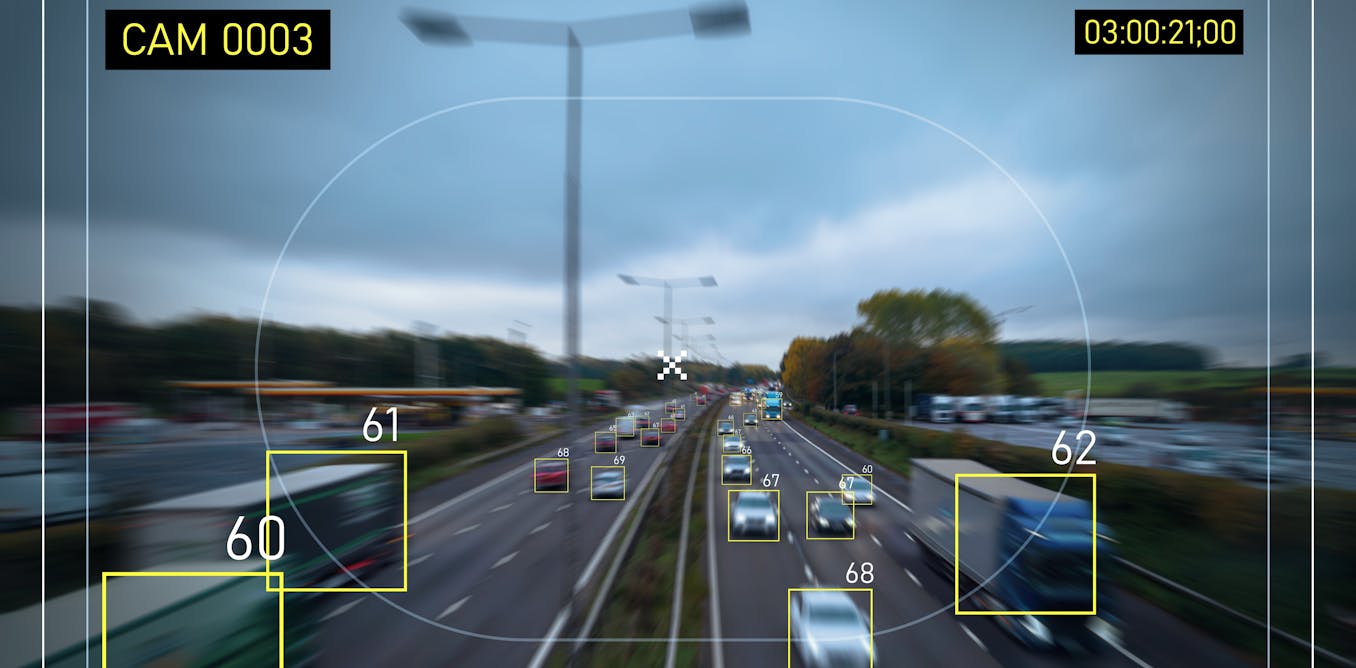
For many people, the rollout of smart technology across the UK’s road network has been clouded by fears about the removal of traffic-free safety lanes. Traditionally, motorway hard shoulders offered motorists a safe haven into which they could steer stricken vehicles.
But amid growing traffic numbers, the rationale for smart motorways (part of the UK government’s wider digital roads plan) was to free up these extra lanes to traffic. During a breakdown, the remote monitoring system could then quickly reinstate a temporary hard shoulder while the broken down or crashed vehicle was removed.
However, since the first official smart motorway system was introduced on the M42 near Birmingham 20 years ago, the public has repeatedly raised concerns that being stranded in a live lane rather than on a hard shoulder can be more dangerous.
In 2020, BBC Panorama reported that 38 people had been killed on smart motorways in the preceding five years. Since then, campaign groups have continued to highlight fatal collisions on smart motorway stretches where broken-down vehicles have been struck in live traffic.
In April 2023, the government’s rollout of more smart motorways in England was halted by then-prime minister Rishi Sunak on the grounds of both safety and cost. However, existing smart motorways remain in operation and continue to receive safety upgrades.
The National Highways’ most recent stocktake on smart motorways in England, published in December 2024, stated: “Overall, in terms of deaths or serious injuries, smart motorways remain our safest roads.”
But the same year, another Panorama investigation found nearly 400 instances where safety technology had lost power on smart motorway stretches between June 2022 and February 2024.
As part of a National Highways-funded research programme, I and other researchers at Cardiff University have worked with drivers and transport-sector experts to explore how people feel about the future of the UK’s road network. We investigated their concerns not only around safety but also surveillance and data collection.
Sense of uncertainty
The UK’s digital roads strategy entails much more than smart motorways. Even after the hiatus on building new smart motorways in England, there is still a growing ecosystem of digital and data-driven technologies embedded across the UK road network. These include roadside sensors to monitor traffic flow, cameras to detect incidents and infrastructure that communicates with control centres.
The aim is not automation for its own sake, but earlier detection of problems, faster response, smoother traffic flow and fewer serious incidents. Artificial intelligence and predictive analytics form part of this system.
Our study shows that most people are not resistant to these innovations on the roads. Many people we spoke to welcomed technologies that promise to improve safety or reduce congestion.
However, what unsettled many of them was the sense of uncertainty they felt about the rollout of these systems.
Some participants worried that data generated through digitally connected vehicles and road infrastructure could eventually “be used by insurance companies to penalise drivers”.
Others raised concerns that “systems designed for traffic management might gradually expand into broader forms of surveillance”.
One participant described the possibility of geolocation data revealing patterns of “my daily or weekly movement in the case of a data breach, which is dangerous”.
Another wondered whether automated sensing technologies might distract drivers who feel compelled to “avoid the sensor that records what I am doing”.
In general, people did not reject technological change out of hand. Rather, they want clearer safeguards around how these systems are governed, who can access the data they generate, and how accountability will be maintained as transport infrastructure becomes increasingly “intelligent”. Their concerns centre on questions of fairness, trust and accountability.
Technology trade-offs
Over the past 20 years, smart motorway schemes are estimated to have cost UK taxpayers billions of pounds.
The M4 smart motorway upgrade alone, between junctions 3 and 12, cost around £848 million. Recent safety reviews have committed a further £900 million to retrofit additional emergency refuge areas and improve detection systems on existing stretches.
But the costs are not only financial. There are also social and institutional costs: public confidence, legitimacy and the burden placed on road users to trust systems they did not choose and may not fully understand.
Understanding these trade-offs is important for the public. Smart road infrastructure represents a major public investment to address genuinely risky situations: broken-down vehicles, sudden congestion, poor visibility or secondary accidents caused by delayed response.
Much of this happens invisibly, which is precisely why transparency matters. When people do not understand what systems are doing, silence is easily interpreted as secrecy. Multiple parliamentary and audit reports have raised questions about whether the smart motorway rollout was too rapid, or communication to the public was inadequate – or both.
Some countries have taken a more explicit approach to public engagement around transport innovation. In Sweden, for example, the national road safety strategy, Vision Zero, was introduced as part of a broad public policy framework that placed societal consent and safety at the centre of infrastructure design.
In the UK’s third road investment strategy (2025-2030), smart roads will probably become more interconnected, more predictive and more automated.
Digital twins – virtual models that replicate real roads and infrastructure so planners can test scenarios before implementing them – will play a larger role in planning. Increased data sharing may allow more integrated services across multiple modes of transport. AI and analytics could increasingly support operational decisions.
But the controversy around smart motorways wasn’t just about design choice. It reflects a deeper public concern: what happens when safety depends on systems people can’t see or easily understand?
To answer this, the systems that run smart roads need to be open and trustworthy, safe and reliable in the eyes of those who rely on them every day.

This research was funded by National Highways. The views expressed in this article are those of the author and do not necessarily reflect the views or position of National Highways.