Since the late 19th century, the art form brewed in the American melting pot has been a powerful tool for social change by challenging racial segregation, promoting equality, and fostering cultural understanding.
As jazz continues to thrive in the 21st Century it has retained its capacity for social commentary and activism according to Sullivan Fortner, a three-Grammy-winning jazz pianist who spoke to UN News at the Village Vanguard jazz club in New York ahead of International Jazz Day which is marked on 30 April.
Jazz musician, Sullivan Fortner, three-time Emmy Award winner.
“Jazz means freedom. Jazz means America. It means humanity. It means love,” said Mr. Fortner insisting that “as long as artists continue to create it, it will always be relevant to the times that we live in.”
The annual celebration of jazz highlights its role as a universal language of freedom, creativity and peace and provides an opportunity to foster greater appreciation, not only for music, but also for the contribution it can make to building more inclusive societies.
“It’s [about] emotional transmission and communicating those emotions and those feelings to each other. Jazz is 100 per cent about that, about the good, the bad and the ugly all in one,” Mr. Fortner said ahead of performing at the storied Village Vanguard.
The club in lower Manhattan – which claims to be the world’s oldest continuously operated jazz club – is arguably the truest representation of the powerful heritage of this sometimes underestimated art form.
From poets to trumpets
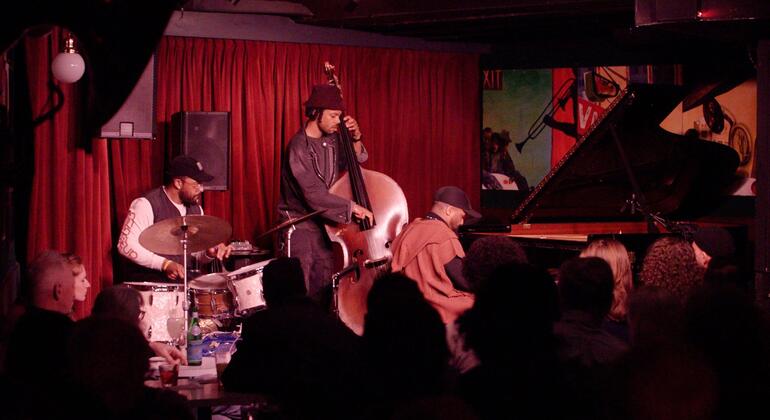
Passing through the Village Vanguard’s vermilion red doors, you descend the narrow staircase into a low-ceilinged triangular room that has been left unchanged for decades; it gives the impression that jazz belongs to a bygone era.
The Village Vanguard jazz club is located in Greenwich Village, New York City.
On the stage a large double bass is keenly sandwiched between a Steinway piano and a stripped-down drum kit. Opposite, rows of antique tables and chairs with their occupants extend back, past pictures of famous performers from over the years – Miles Davis and John Coltrane among them – toward a colourful mural on the back wall.
“We try to keep it very simple here,” owner Deborah Gordon, said.
But when the Sullivan Fortner Trio comes swinging through the back doors toward the stage, the band starts to improvise and the space leaps from nostalgia into something very alive. We enter that unpredictable territory with them.
Unity through jazz
The Village Vanguard used to welcome all sorts of artists from poets to calypso dancers to folk singers and was a “platform to present all kinds of cultural and political events”, Ms. Gordon said.
In 1957, the club decided jazz was the best way of providing that platform and it became the exclusive medium on stage.
Aside from a brief period after the Second World War, when jazz entered the mainstream, “it’s always been a kind of fringe, specialized audience that it draws,” Ms. Gordon said.
“There’s a lot of gray heads like me, and there are a lot of young people like you too, it’s a big mix of people” she said.
April 30 is the International Jazz Day
Melodies and messages
As Sullivan Fortner and his trio continue performing, shifting between melodies, there’s a hidden current that rides the room.
“It’s like an energy going from the music, from the stage to the people. And back…it’s a circular kind of thing…and you can really feel the uniting force of what the music can bring,” Ms. Gordon said.
Evolution and revolution
Its unifying force is what made it a tool of empowerment and social change for marginalised Black communities in New Orleans, where jazz first started.
“The way the music started was out of sheer protest…we were birthed out of a rebellion of artists trying to take a stance,” Mr. Fortner said.
Later artists such as Bille Holiday protested racial injustice and promoted integration through her music as jazz became a soundtrack to the Civil Rights Movement in the United States.
Today, jazz is constantly changing, “It’s incorporating different kinds of music all the time from different places,” Ms. Gordon said.
“Jazz is beyond notes and rhythms. It’s language. It’s the way people speak. It’s the way people gesture to one another.” Mr. Fortner added.
As jazz takes on new instruments and forms of expression, it has retained its capacity for social commentary and activism.
Don’t forget the streets
Speaking about its place in music today, Ms. Gordon said: “It’s still a peripheral kind of music in the culture. And I’m good with that, because to me, that means it will last. It’s not a flash in the pan. It’s solid. And within that solidity, it changes and evolves.”
Though many now view jazz as a high-art form, much like classical music, musicians say it must not forget its roots.
“Sometimes we’ve gotten so intellectually profound that we forgot to reach and take the gutter with us. I feel like we can’t forget that this was birthed in the streets, that it was birthed in brothels,” Mr. Fortner said.
“We have to remember that this is street music and that it has to be accessible to people who may not necessarily have shoes,” he added.
“We have to remember that and take those people with us whenever we perform or whatever we play.”