As the Earth shifts to climates not seen for several hundred thousand years, we may need to look at ancient environments for clues about what could happen next.
Our new study of two whale fossils, with preserved fragments of shark teeth, suggests the modern descendants of these animals could once again roam the southern region of the North Sea, between the UK, Belgium and Denmark. Climate change may recreate the conditions that allowed the ancestors of great white sharks to hunt in these waters.
If you want information about how animals and other organisms might respond to the kind of climate changes our planet is experiencing right now, you need evidence of former responses to such changes.
Palaeoecology, the study of the interactions between organisms in the deep past, has been coopted in the service of conservation science for some years now.
One example of a past seascape which may tell us important information is that of the southern part of the North Sea, which was occupied a few million years ago by large marine animals. In modern times, the area has had a relatively low diversity in its wildlife.
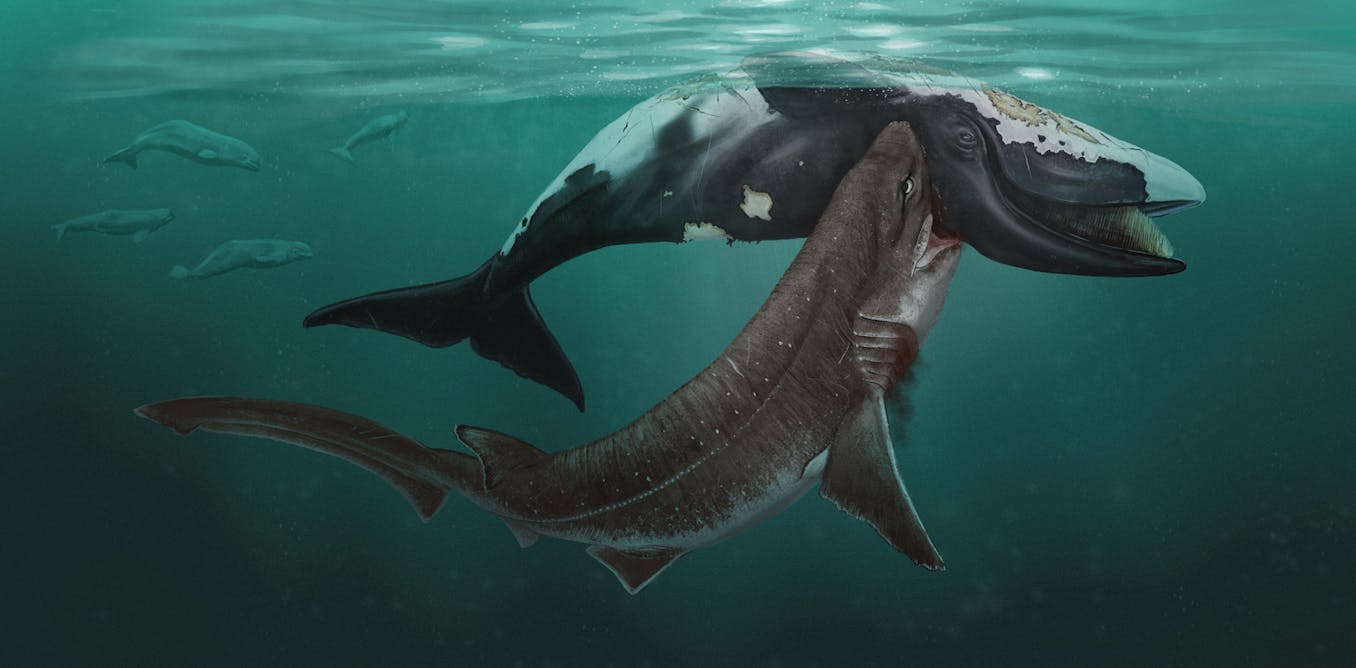
But about 4-5 million years ago the North Sea was home to several large shark species, including the now locally extinct bluntnose sixgill shark and a relative of the modern great white shark. The Greenland shark used to live in this region, as well as tiny right whales, a relative of the beluga whale, and rorqual baleen whales. It was also home to extinct dolphins, such as Pliodelphis doelensis which was about the size of a common dolphin, plus porpoises and several seal species. Many of these animals, like all the cetaceans and seals, and some of the sharks, are now extinct. Others, including many other sharks, have since moved to distant oceans.
It appears that there was large-scale turnover of cetacean species in the southern North Sea during the ice age of the Pliocene-Pleistocene epoch, with the extinctions of most small baleen whales and the departure of other cetacean families (such as that of the beluga whale). This turnover may well have been responsible for the disappearance of the large sharks including the great white relatives and the bluntnose sixgill sharks, that were feeding on the smaller whales, from the North Sea.
Occasionally, the fossil record provides a glimpse of the past relationships between species. This can help scientists better understand these food webs and how ancient ecosystems worked.
Shark bite marks on fossil marine mammal bones are relatively common, revealing intervals of time when two animals interacted. However, it is often difficult to identify the predator species. Much more rarely, bite marks come with fossilised tooth fragments. This is what we found in two cetacean skulls from the Early Pliocene (approximately 5-4 million years ago) of the North Sea.
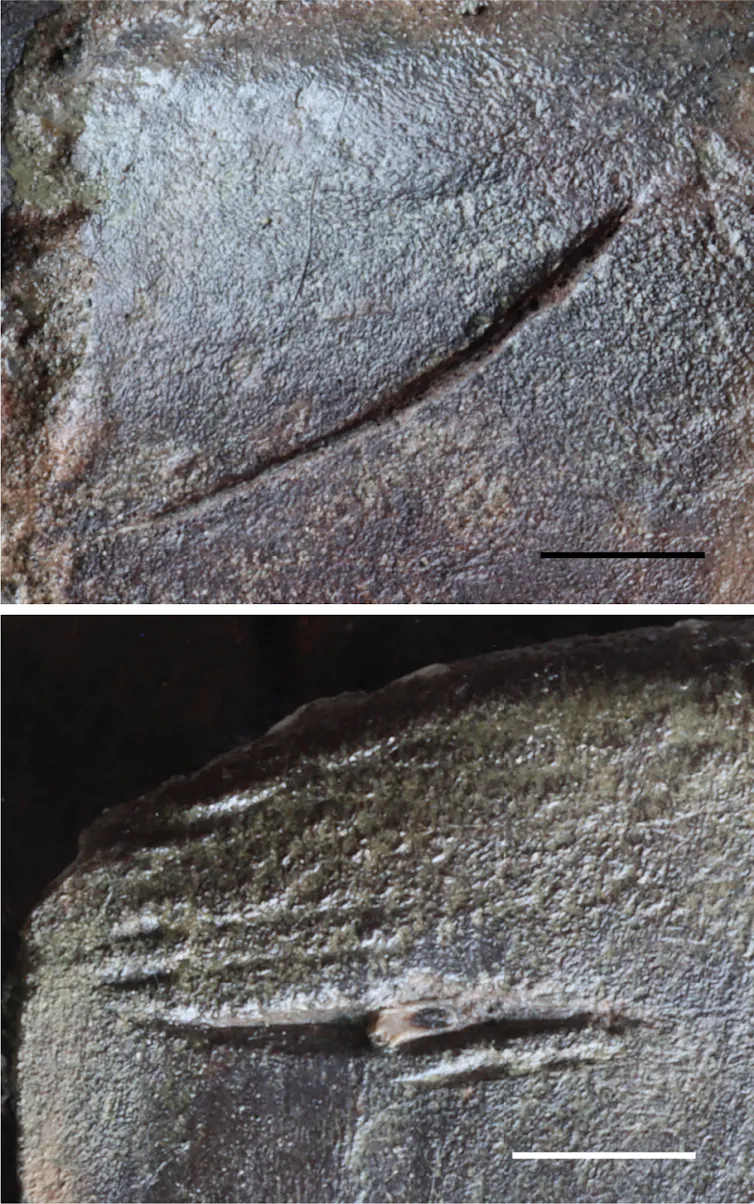
Olivier Lambert (RBINS)., CC BY-NC-ND
The first of these two skulls belonged to a diminutive extinct right whale which was found by father and son fossil enthusiasts (Robert and John Stewart – coauthor of this piece) in the mid-1980s in the docks in Antwerp, Belgium. Some 40 or so years later the skull was donated to the Institute of Natural Sciences in Brussels where it was identified by one of us (Olivier Lambert) as one of only two fossil specimens of Balaenella brachyrhynus, a tiny right whale species only known from the North Sea.
Further examination revealed bite marks on the top of the skull and in one such mark there was a tooth fragment of a shark. In our study, with the help of the shark specialist Frederik Mollen, the tooth tip was identified using microCT scanning as belonging to part of a lower tooth of a bluntnose sixgill shark Hexanchus griseus, which today is common in the Mediterranean Sea. The position of the bites makes it likely that the whale was scavenged as it lay drifting belly-up.
The second skull, from a close relative of the extinct beluga whale Casatia thermophila was discovered in the early 1980s. It was found during the excavation of a new dock in the Port of Antwerp by another father and son team – Paul Gigase, a pathologist by profession, and his son Pierre.
In this case the whale, which also had bite marks with the tip of a shark tooth embedded, may have been attacked by an extinct mako shark, a relative of today’s great white shark. It appears that the shark was attempting to separate the whale’s head from the rest of the body and focusing on the fat-rich melon, a mass of tissue involved in echolocation on the top of the animal’s head.
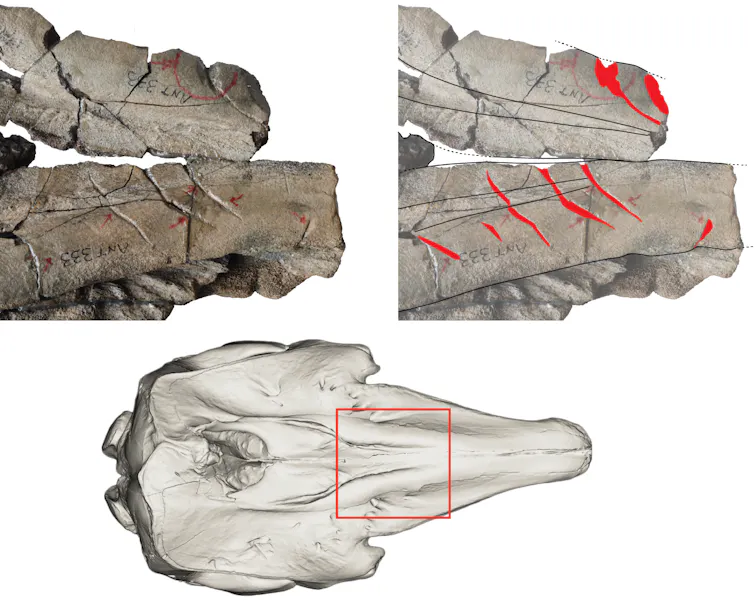
Olivier Lambert (RBINS)., CC BY-NC-ND
These fossils represent direct evidence that relatives of sharks today fed on these whales. Even if the fossil evidence is limited to two pairs of animals, they are tangible examples of such behaviour.
The ongoing biodiversity crisis is directly related to climate change, and has (or will have) an impact on the distribution of marine mammals. Global warming is likely to affect shallow seas in particular. The southern part of the North Sea is not large or deep enough for modern baleen whales, which are larger than their ancestors and live in the North Atlantic, like the modern right whale, the humpback and fin whales. But warming seas could attract dolphins and seals, and in turn great white sharks or other large marine predators.
In the North Sea, scientists have already observed short-term changes in the distribution of porpoises and seals. New seal colonies have established along the coast of the southern North Sea and there have been abrupt fluctuations in the number of porpoises stranded yearly on Belgian beaches.
The fossilised behaviour of the disappeared whales and sharks emphasise that all is change in the ecology of the North Sea.

The authors do not work for, consult, own shares in or receive funding from any company or organisation that would benefit from this article, and have disclosed no relevant affiliations beyond their academic appointment.