WASHINGTON — In a move intended to fracture the inner circle of the Iranian regime, the U.S. State Department’s Rewards for Justice program announced a reward of up to $10 million on Friday, March 13, 2026. The bounty targets information leading to the location or identification of Iran’s new Supreme Leader, Ayatollah Mojtaba Khamenei, along with nine other senior officials and commanders within the Islamic Revolutionary Guard Corps (IRGC).
The announcement comes as Washington characterizes the new leadership as a “terrorist command” and marks the first time a reward has been placed on a sitting Iranian Supreme Leader.
The Targets: A Command in the Shadows
The State Department’s list includes the highest echelons of Iran’s security and political apparatus. Many of those named have not been seen in public since the start of the war on February 28.
- Mojtaba Khamenei: The 56-year-old son of the late Ali Khamenei, who succeeded his father just five days ago. U.S. officials, including Defense Secretary Pete Hegseth, have recently claimed he is “wounded and likely disfigured” following initial strikes.
- The Named Officials: The bounty also targets Ali Larijani (Secretary of the Supreme National Security Council), Eskandar Momeni (Interior Minister), and Esmail Khatib (Minister of Intelligence).
- The “Unknown” Commanders: Notably, four of the targets are listed only by their titles, including the Commander-in-Chief of the IRGC and the Head of the Supreme Leader’s Military Office, suggesting a significant intelligence gap regarding who currently holds functional control over Iran’s armed forces.
“Cash and Relocation”
The U.S. is utilizing a “high-incentive” strategy to encourage defections and intelligence leaks during the height of the military campaign.
- Maximum Bounty: The $10 million cap is among the highest ever offered for state officials under the Rewards for Justice program, rivaling bounties previously placed on the leaders of Al-Qaeda and ISIS.
- Protective Measures: The State Department confirmed that credible informants are eligible for permanent relocation outside of the region, emphasizing that all tips can be submitted via encrypted messaging platforms or the Tor network to ensure anonymity.
- Legal Justification: The State Department designated the IRGC as a Foreign Terrorist Organization in 2019, providing the legal framework to offer rewards for information that disrupts its financial mechanisms or identifies its key leaders.
Psychological Warfare at a Critical Juncture
The timing of the bounty coincided with the expiration of President Donald Trump’s “Saturday Ultimatum” to Tehran. By placing a price on the heads of the leadership, the U.S. aims to:
- Sow Distrust: Foster paranoia within the IRGC’s command structure as the “Saturday Strike” looms.
- Support Protests: Signal to internal dissidents and protesters—whom President Trump recently praised on Fox News Radio—that the U.S. considers the current regime to be illegitimate “terrorist” actors.
- Pressure the Axis: Disrupt the coordination of the “Axis of Resistance” by targeting the specific individuals who manage proxy networks in Lebanon, Yemen, and Iraq.
Tehran’s Defiance
In a swift response via state-controlled media, Ali Larijani dismissed the bounty and the claims regarding the Supreme Leader’s health. He accused Secretary Hegseth of engaging in “desperate fiction” and characterized the U.S. move as an admission of failure in its conventional military objectives.
As the U.S. military prepares for what it describes as the “heaviest strikes to date” over the weekend, the $10 million offer serves as a digital front in a war that is increasingly being fought through both kinetic bombardment and aggressive information operations.
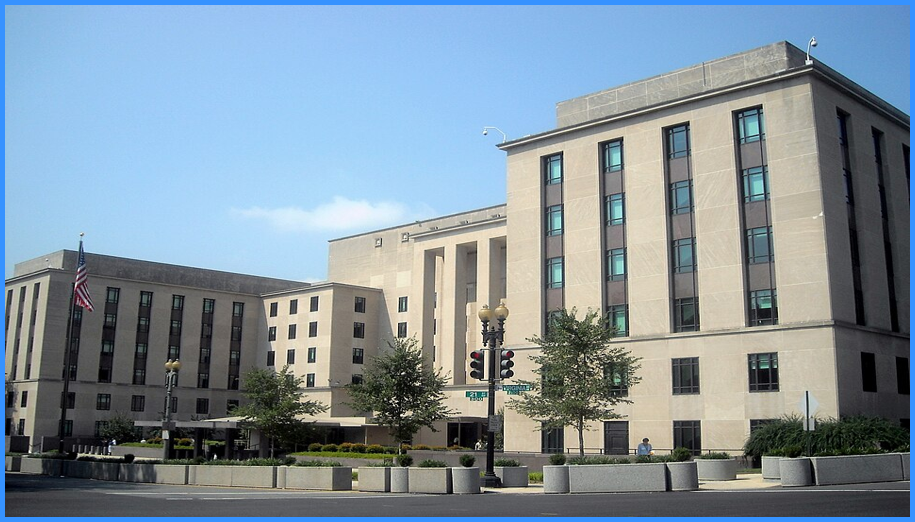
United States Department of State. The Harry S. Truman Building, Image by AgnosticPreachersKid