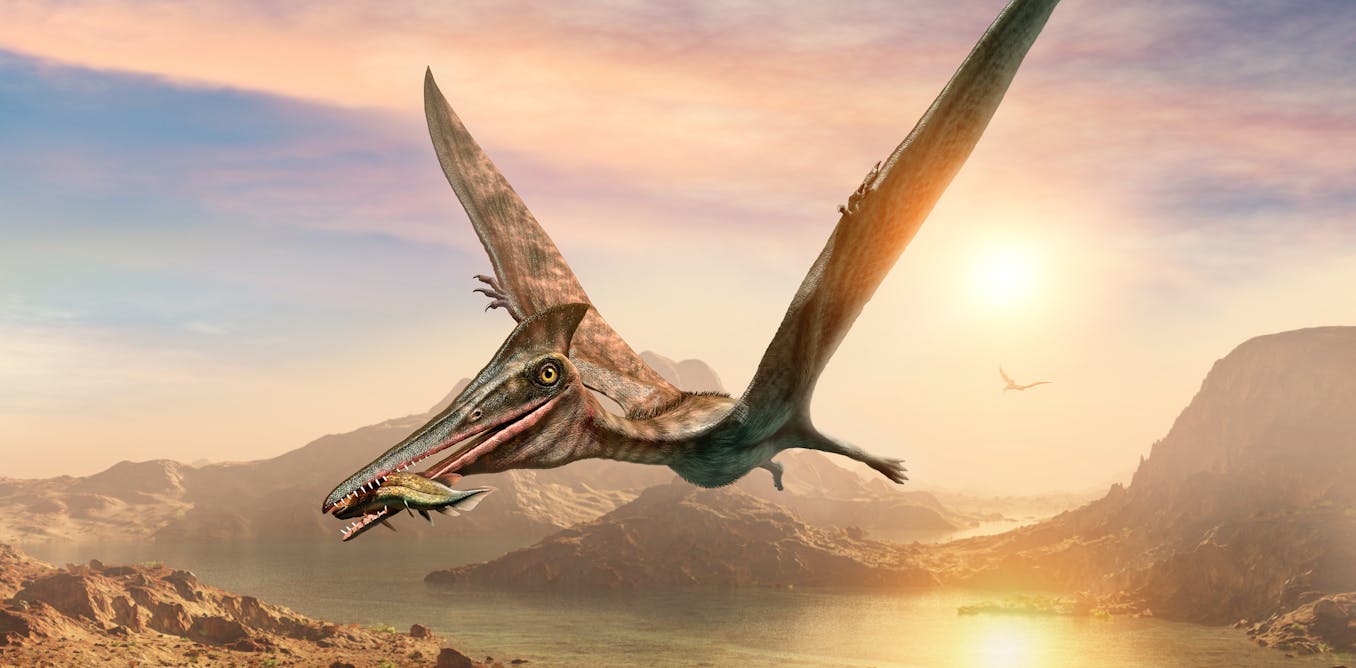
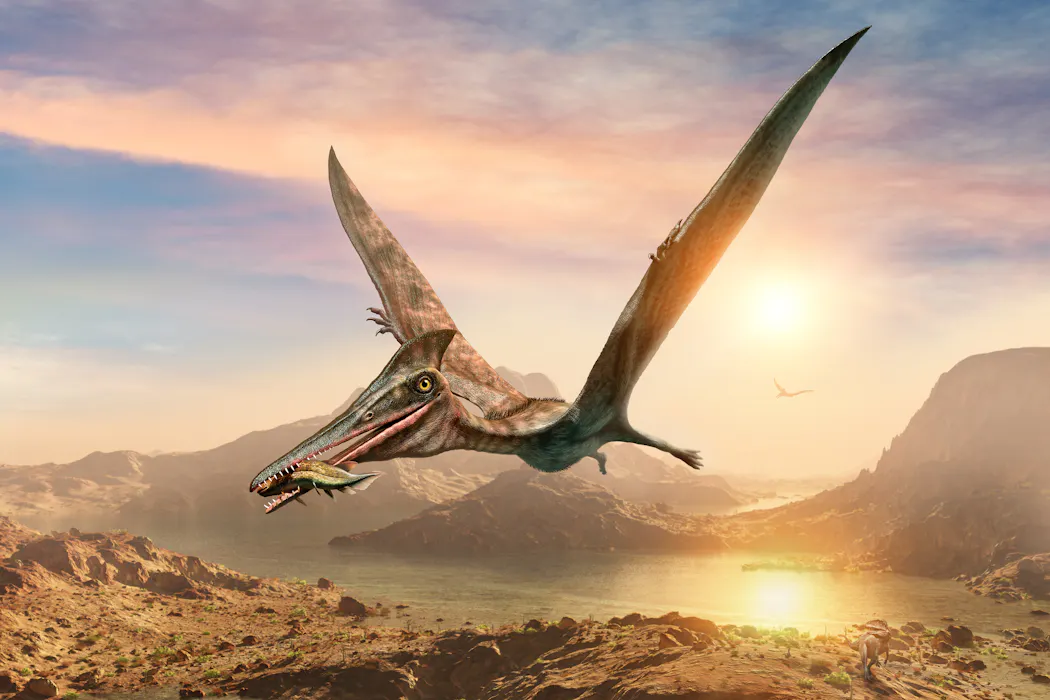
Georges Cuvier, the 19th-century French anatomist who first recognised pterodactyls as flying reptiles, wrote that “of all the beings whose ancient existence has been revealed to us, [they are] the most extraordinary”.
Now known as pterosaurs, this extraordinarily diverse, highly successful group lived alongside dinosaurs for more than 150 million years, occupying habitats around rivers, lakes, coasts and even the open ocean. While some species were quite small (no bigger than a pigeon), a few evolved into flying giants with wingspans exceeding ten metres.

David Unwin, CC BY
Pterosaurs are unlike any other animal, living or extinct. Despite this, a surprisingly long list of fossils have been misidentified as pterosaurs – including a specimen of the earliest bird, Archaeopteryx, and an extinct aquatic reptile, Tanystropheus, which had extraordinarily long neck vertebrae like some pterosaurs.
One of the most renowned misidentifications occurred in 1939 when Ferdinand Broili, a Munich-based palaeontologist, described a new pterosaur, Belonochasma, based on what appeared to be the remains of jaws bearing hundreds of long, fine teeth.
Several decades later, Franz Mayr, founder of the Jura Museum in Eichstätt, Germany, recognised the true nature of these remains. The “teeth” were actually gill filaments. More complete fossils, including remains of the body, showed unequivocally that Belonochasma was actually a fish.
Back in the 1930s, it could be years before publications became widely known and decades before errors were corrected. The gentle pace of research meant misidentifications usually had little impact.
Contrast that with today’s digiverse. Now, most palaeontologists are aware of newly published research within days or even hours of publication – and can immediately start downloading datasets that include it.
This rapid dissemination and repurposing of data – in the case of palaeontology, relating to age, geographic location and bodily structure – mean that errors can also spread very quickly.
A highly unusual fossil
In November 2025, a team of Brazilian palaeontologists led by Rodrigo Pêgas, based in the Museum of Zoology at the University of São Paulo, described what they took to be a new pterosaur. Bakiribu waridza had been found in 110 million-year-old Early Cretaceous rock of Araripe in northeast Brazil.
This highly unusual fossil apparently comprised several small fish plus the remains of not one but two pterosaurs – each represented by what were claimed to be fragmentary remains of jaws, plus hundreds of fine teeth.

David Unwin, CC BY
Pêgas and colleagues speculated that these specimens were contained in dinosaur vomit (known as regurgitalite) so large that it could only have been produced by a huge predator – perhaps a Spinosaurus-like theropod dinosaur. Enthusiastically promoted, the newly announced Bakiribu drew much attention, including numerous palaeoartists’ impressions and its own Wikipedia page.
However, a group of us who study pterosaurs – including David Martill and Roy Smith from the University of Portsmouth, and Sam Cooper from the Stuttgart State Museum of Natural History – soon spotted some problems.

David Unwin, CC BY
Comparing our extensive collection of high-resolution digital photographs of pterosaur fossils with published images of Bakiribu, it appeared that its “teeth” did not extend along both sides of the jaw in symmetric fashion, as with all toothed pterosaurs. They also lacked a root, which is omnipresent in pterosaur teeth. Moreover, features such as dentine and dentine tubules, typical of pterosaur teeth, appeared to be absent.
We also noticed that bone fragments associated with the supposed jaws did not match any cranial element of pterosaurs, and their coarse external texture was unlike the smooth finish typical of pterosaur bone.
So, what was Bakiribu? Martill recalled the 1939 Belonochasma episode, which prompted me to examine the original fossil during a visit to Munich earlier this year. It was immediately clear that Belonochasma and Bakiribu were remarkably similar.
Comparing Bakiribu with the fossil remains of ancient bowfins discovered in the same rocks, and taking advantage of Cooper’s expertise in fossilised fish, we were able to identify the supposed teeth of Bakiribu as gill filaments, and the associated bony elements as branchials (structures that support the gills). Like Belonochasma, the Bakiribu fossil was in fact a collapsed gill arch of a large fish, preserved alongside two smaller fish.

Zachary Randall, CC BY
A paper detailing our findings has just appeared in the Annals of the Brazilian Academy of Sciences. Pegas and colleagues, who disagree with our conclusions, were offered an opportunity to publish a response in the same issue of the journal, but did not take up this invitation.
Misidentifications matter more now
All palaeontologists – myself included – have misidentified at least one fossil during their careers. The fragmentary, incomplete nature of many fossil remains means erroneous identifications are as inevitable as death and taxes.
But in today’s world of rapid international communication, it is all the more important that they are highlighted as quickly as possible. Fortunately, the digiverse can also help do this.
Within five weeks of the first appearance of Bakiribu, our team flagged the possibility of a misidentification by posting a reinterpretation as a non-peer reviewed “preprint” article. And only five months later, our fully peer-reviewed account was published.
The speed of the digiverse means this alleged regurgitalite has rapidly been regurgitated. But doubtless many other misidentified fossils remain unsuspected, and more mistakes will be made in the future.
Once spotted, however, at least we have the tools to quickly verify such errors, in order to restrict their impact on the body palaeontologic.

David Unwin does not work for, consult, own shares in or receive funding from any company or organisation that would benefit from this article, and has disclosed no relevant affiliations beyond their academic appointment.