In a major escalation of the maritime blockade around Venezuela, U.S. forces conducted back-to-back seizures of two sanctioned oil tankers on Wednesday, January 7, 2026. The operations, occurring in the North Atlantic and the Caribbean, mark a historic shift in the Trump administration’s “maximum pressure” campaign, featuring the first direct seizure of a Russian-flagged vessel by the U.S. military in recent history.
The primary target, the M/T Marinera (formerly the Bella 1), was intercepted in the volatile waters of the “GIUK Gap” between Iceland and Scotland. Simultaneously, a second vessel, the M/T Sophia, was boarded by tactical teams in the Caribbean Sea.
The Flight of the Marinera
The seizure of the Marinera concludes a dramatic three-week pursuit that began in mid-December. After refusing a U.S. Coast Guard boarding attempt near Venezuela, the tanker fled across the Atlantic, executing a series of deceptive maneuvers:
- Identity Shift: While in transit, the crew reportedly repainted the hull, renamed the ship, and re-registered it under the Russian flag.
- False Flagging: The U.S. Department of Justice alleges the vessel flew multiple false flags and disabled its transponders to evade the “ghost fleet” blockade.
- Strategic Escort: Moscow reportedly deployed a submarine and naval assets to shadow the vessel, though no direct kinetic engagement occurred during the boarding by the USCGC Munro.
International Fallout: Diplomacy vs. Force
While Washington frames the seizures as a “whole-of-government” enforcement of federal warrants, international observers and sector regulators have issued urgent warnings and urged for a more cautious approach from all parties to de- escalate the volatile situation.
| Stakeholder | Position | Official Statement |
| U.S. State Dept. | Enforcement | “We go to court, we get a warrant, we seize those boats. And that will continue.” — Marco Rubio |
| Russia | Condemnation | Labeled the act “piracy,” citing the 1982 UN Convention on the Law of the Sea. |
| China | Cautionary | Warned that “aggravations” risk a direct clash between superpowers over freedom of navigation. |
| UK MoD | Support | Confirmed RAF and Naval support, citing the ship’s links to “international terrorism.” |
The “Operation Southern Spear” Context
These seizures follow the stunning capture of Venezuelan leader Nicolás Maduro by U.S. forces just days ago. The administration has since pivoted to a strategy of “selective decertification,” seizing tankers to redirect oil revenue into U.S.-controlled accounts, a move President Trump claims could yield 30 to 50 million barrels for the domestic market.
A New Geopolitical Flashpoint
The use of military force to board a vessel under the Russian flag has set a “dangerous precedent,” according to maritime analysts. With China and Russia increasingly protective of their “shadow fleet” supply lines, the North Atlantic has become a high-stakes arena where a single miscalculation could trigger a broader conflict.
As the Marinera is escorted toward a U.S. port, the world watches to see if the Kremlin will respond with more than just diplomatic protests.
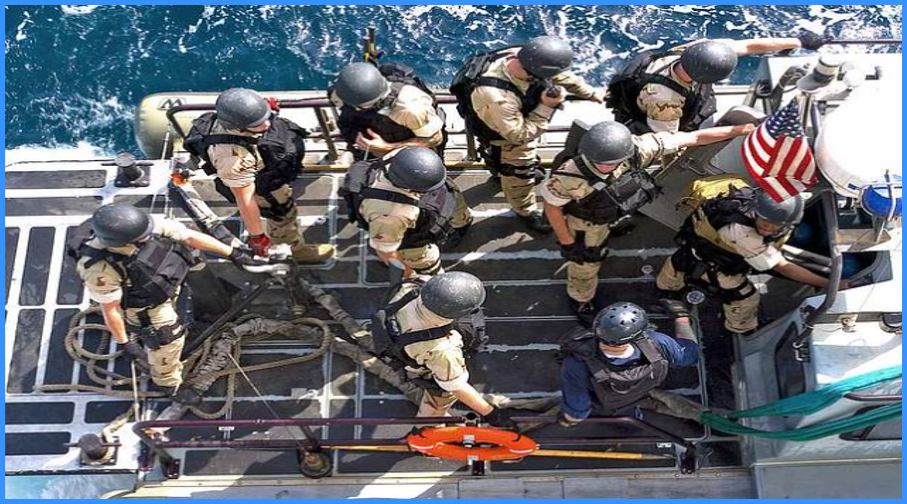
U.S. Forces Seizure Team Picture from Picryl (Public Domain)