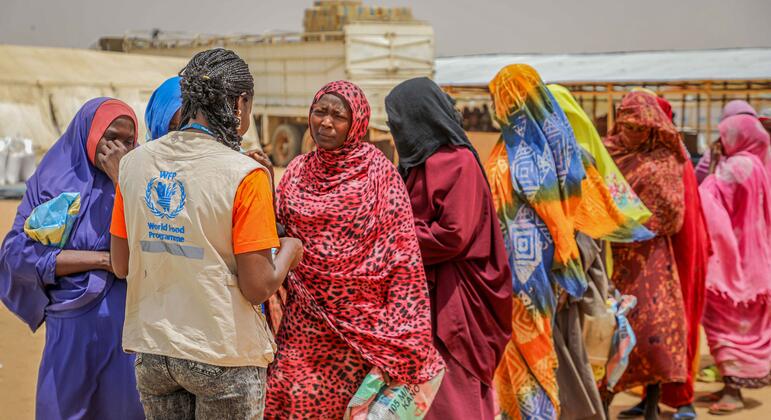
The warning comes from the UN refugee agency, UNHCR, and the World Food Programme (WFP).
They said “essential assistance to the refugees will be drastically scaled back even further in the coming months” unless a $428 million shortfall is met.
Hosting 1.3 million
Chad is hosting some 1.3 million people who have fled Sudan, with the majority – over 900,000 – arriving since the start of the war between rival militaries that erupted in April 2023.
Host communities continue to receive new arrivals, including nearly 15,000 since the start of the year.
South Sudan: ‘Alarming child trafficking crisis’
A Human Rights Council-appointed independent expert on Thursday raised the alarm over an escalation in conflict-related trafficking in South Sudan, describing the situation as a “dire humanitarian crisis”.
Siobhán Mullally, the Special Rapporteur on trafficking in persons, warned that widespread attacks on civilians are having a “disproportionate impact on children”.
The crisis is being fuelled by massive displacement, with 1.4 million people fleeing the war in neighbouring Sudan joining nearly two million internally displaced South Sudanese.
Dangerous ‘normalisation’
Ms. Mullally noted that conflict-related sexual violence has become “normalised”, with girls trafficked for sexual slavery and forced into pregnancies. Meanwhile, boys face forced recruitment into combat roles.
“Abductions for sexual slavery, forced recruitment, child and forced marriage and sexual exploitation are grave violations of international law that may amount to war crimes,” she said.
Highlighting a culture of “widespread impunity”, she called for the urgent operationalisation of the African Union-mandated Hybrid Court to ensure justice for survivors.
Burundi: Five dead from ‘mystery illness’
Health authorities in Burundi, supported by the UN World Health Organization (WHO), are racing to identify a mysterious illness that has claimed five lives in the country’s north.
The outbreak, centred in the Mpanda district near the border with the Democratic Republic of the Congo, has so far sickened 28 people.
The cases, first reported on 30 March, have primarily affected members of the same household.
Severe symptoms
Patients have presented with severe symptoms including fever, vomiting, diarrhoea, and blood in their urine, with some cases exhibiting jaundice and anaemia.
While initial tests for Ebola and Marburg virus diseases returned negative results, further laboratory analyses are ongoing.
The WHO is currently supporting the Ministry of Health to “strengthen disease surveillance, field investigation, clinical care, and laboratory diagnosis”.
A joint team of experts has been deployed to the field to coordinate the response and “sustain key operations” in a bid to contain the spread.
Serbia: ‘Erosion of civic space’ very worrying
UN human rights chief Volker Türk has warned of a “very worrying” deterioration of democratic freedoms in Serbia.
The High Commissioner expressed concern over increasing restrictions on civic space, citing continuous attacks against critical voices and significant constraints on media freedom.
Recent local elections were marred by reports of voter intimidation, procedural irregularities, and police raids on opposition premises, which Mr. Türk said “raise serious questions about the integrity” of the electoral process.
Reporters targeted
He also highlighted the “continued targeting of journalists” and mounting pressure on independent media outlets as evidence of a declining democratic environment.
The UN rights chief urged the Serbian authorities to uphold the rights to freedom of expression and peaceful assembly.
He called for “concrete steps” to restore public trust in national institutions through transparent and impartial investigations into human rights violations, stressing that there must be “accountability for any wrongdoing”.