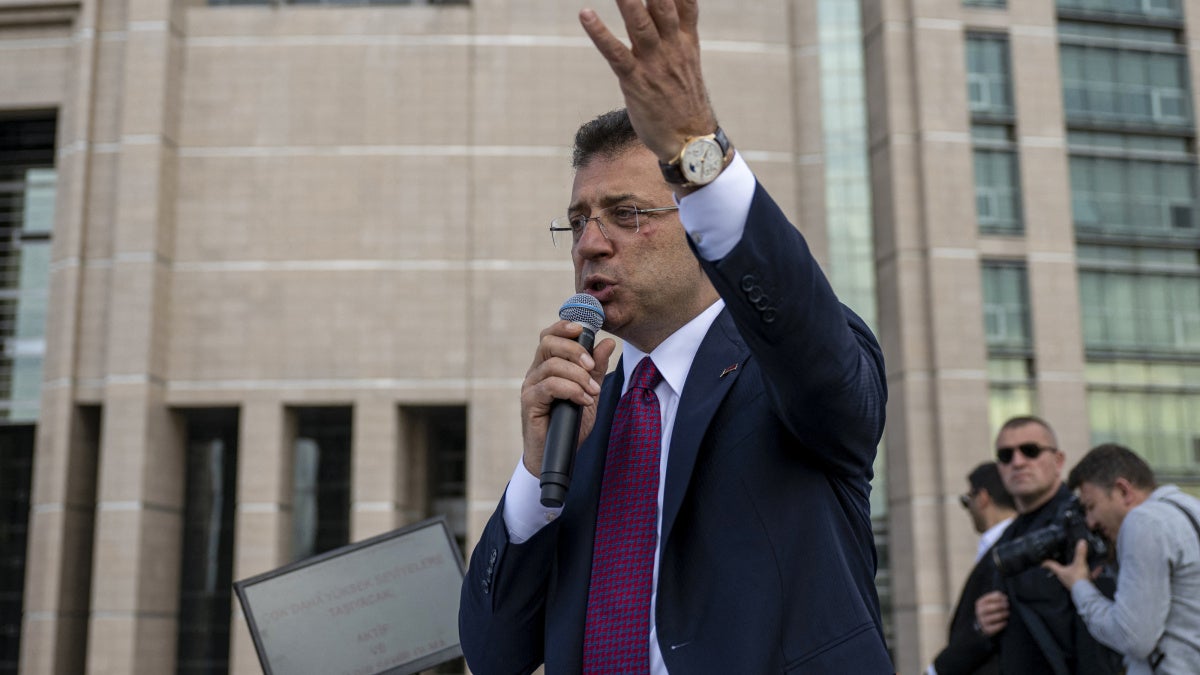
- The Istanbul mayor and main opposition Republican People’s Party presidential candidate Ekrem İmamoğlu will stand trial on March 9 as the central defendant in a politically motivated mass corruption prosecution of 407 defendants which raises serious fair trial concerns
- The case is the culmination of a 17-month campaign by the Turkish authorities against the main opposition party through criminal investigations, detentions and other lawsuits targeting İmamoğlu, other elected officials and the party leadership, pointing to a concerted effort to remove İmamoğlu from politics and discredit his party in ways that undermine democracy
- The use of detention and legal processes to challenge elected opposition party officials undermine the party’s ability to compete with the ruling party in future elections and citizens’ right to freely express support for candidates of their choosing.
(Istanbul, March 3, 2026) – The Istanbul mayor and presidential candidate Ekrem İmamoğlu will stand trial on March 9, 2026, as the central defendant in a politically motivated mass corruption prosecution, Human Rights Watch said today. Most of the 407 defendants worked for the Istanbul Metropolitan Municipality.
İmamoğlu has spent a year in detention during investigations and prosecutions targeting elected officials from the party with which he is affiliated, the Republican People’s Party (CHP), Türkiye’s main opposition party. A court ordered his detention on the day party members selected him as their presidential candidate. Human Rights Watch issued a timeline setting out the sequence of government moves corroborating concerns that the cases targeting İmamoğlu and the party are politically motivated.
“The trial of Mayor Ekrem İmamoğlu follows more than a year of weaponizing the criminal justice system against his party and other CHP elected officials while he sits in jail,” said Benjamin Ward, deputy Europe and Central Asia director at Human Rights watch, “Looking at these cases as a whole, it’s hard to avoid the conclusion that prosecutors are trying to remove İmamoğlu from politics and discredit his party in ways that undermine democracy.”
Human Rights Watch interviewed lawyers for the defendants, examined legal documents and public statements by the İstanbul public prosecutor’s office, and verified media reports. Researchers also analyzed presidential statements about İmamoğlu and other CHP officials. The timeline of events created illustrates the scale since late 2024 of corruption and terrorism investigations that target CHP mayors and municipalities in Istanbul and other major cities, alongside efforts through the courts to discredit the national leadership of the CHP.
İmamoğlu faces allegations that he used the cover of his public office from 2014 to 2025 to establish what the prosecution calls “the İmamoğlu criminal organization for illicit gain,” with the aim of enriching himself and enabling “the organization’s capture of the [Republican People’s] Party” and his election as president of Türkiye. If convicted on all counts, İmamoğlu could face a prison term of up to 1929 years.
Similar to many other politically motivated trials in Türkiye, the bulk of the evidence consists of statements by 15 witnesses whose identities are withheld from the defense—“secret witnesses” — and from among 76 defendants in the trial who have agreed to testify in exchange for a possibly reduced sentence.
Reliance on such evidence, along with prejudicial statements by prosecutors and Turkish President Erdoğan about İmamoğlu and the party, undermines İmamoğlu’s right to a fair trial, Human Rights Watch said. The jailing of İmamoğlu’s defense lawyer as a defendant in the case, the large number of defendants, and the complexity of the proceedings all contribute to serious fair trial concerns.
In the March 2024 local elections, CHP received 37.8 percent of the vote nationally, surpassing President Recep Tayyip Erdoğan’s Justice and Development Party (AKP), which received 35.5 percent and lost its lead for the first time in 22 years.
Investigations against the CHP began in Istanbul after the October 2024 appointment of Deputy Justice Minister Akın Gürlek as Istanbul chief public prosecutor. On February 10, 2026, on completion of the investigations into İmamoğlu, Gürlek was appointed justice minister. Gürlek’s successive appointments highlight the flagrant nature of government influence over prosecutorial and judicial appointments and decision making in Türkiye, Human Rights Watch said.
The Istanbul public prosecutor’s office’s investigation coincided with the mayor’s political rise. On February 22, 2025, the day after İmamoğlu announced his presidential candidacy and officially submitted his application to the CHP, the Istanbul public prosecutor’s office opened an investigation into an allegation that İmamoğlu’s university diploma—a requirement for presidential candidacy—had been falsified.
On March 18, 2025, four days before party members were due to select him, Istanbul University cancelled the diploma, and the Istanbul public prosecutor’s office ordered İmamoğlu’s arrest on March 19 in connection with an organized crime and corruption investigation and for terrorism links. A court ordered his detention on suspicion of organized crime and corruption on March 23, the day his party was due to confirm his presidential candidacy.
In October, the Istanbul public prosecutor’s office began a third investigation against İmamoğlu for espionage, alleging he had leaked data about voters to foreign countries, and a court also ordered his detention in this separate investigation. On February 4, 2026, he was indicted for espionage, with three others, and faces a 15-20 year prison term if convicted.
In addition to the cases against İmamoğlu, legal processes challenging the validity of CHP leadership elections at party congresses, and the detention and removal of CHP mayors in other Istanbul districts and in major cities like Adana and Antalya, undermine the ability of the CHP to operate effectively as an opposition party to compete with the ruling Justice and Development Party-Nationalist Action Party (AKP-MHP) coalition in future presidential, parliamentary and local elections.
This impact strongly suggests that the detention of İmamoğlu and other elected mayors, as well as the criminal proceedings brought against them, have an improper purpose and violate the safeguards in article 18 of the European Convention on Human Rights, which prohibits states from using restrictions on rights for purposes other than those for which they were intended. The cases also raise concerns about the Turkish authorities’ interference with the rights to political participation, to freedom of expression, and to a fair trial.
Independent TV news channels perceived as being close to the political opposition have faced fines, broadcast bans, investigations, and detentions of journalists for their critical news coverage of the arrest of İmamoğlu and the crackdown on the opposition.
“Opposition parties and politicians that can function freely are a crucial element of a democratic system and ensure voters have a real choice in free and fair elections,” Ward said. “With the president declaring the guilt of his rivals, prosecutors jailing and seeking to disqualify İmamoğlu and other elected officials, and a barrage of cases all against one party, the democratic process in Türkiye has never looked at greater risk.”
Multiple Cases Against İmamoğlu
Since first winning the Istanbul mayoral election in 2019, İmamoğlu has faced several abusive prosecutions, alongside multiple civil cases. He has been prosecuted for political speeches that have not advocated violence and are firmly within the boundaries of protected free speech.
Notable among them is his 2022 conviction for allegedly insulting members of the Supreme Election Council (YSK), that resulted in a two year, seven month prison term and political ban. The conviction is currently on appeal before the Court of Cassation.
İmamoğlu has also been prosecuted and convicted for criticizing Gürlek, the chief prosecutor, who directly oversaw the main criminal investigation against him. After describing Gürlek’s “reasoning” as “rotten,” İmamoğlu was indicted on February 5, 2025, on charges of targeting a counterterrorism official, insulting a public official, and making threats, and was convicted on the latter two offenses on July 16 and sentenced to 20 months in prison.
For a prosecutor to file a personal criminal complaint against someone whose investigation they are overseeing is an unacceptable conflict of interest. That conviction is on appeal.
İmamoğlu was indicted again on June 24, 2025, after a prosecutor accused him of slander on the basis of statements İmamoğlu made during an interrogation on March 23, 2025. İmamoğlu made a payment to settle the case out of court and have the charge dropped.
These cases underscore the problematic nature of Türkiye’s criminal defamation laws. European Court of Human Rights judgments have repeatedly ordered changes to the laws to protect the right to freedom of expression under the European Convention on Human Rights.
In September 2024, İmamoğlu was acquitted of charges, brought in January 2023, that he had rigged tendering bids during his term as mayor of Istanbul’s Beylikdüzü district (between 2014 and 2019) before he was elected mayor of Istanbul.
İmamoğlu is also currently on trial on charges of having a forged university diploma on the grounds that his 1990 transfer from a university in northern Cyprus to Istanbul University was not lawful. He was indicted for this offense on July 4, 2025.
Istanbul Metropolitan Municipality case
The main case against İmamoğlu, which led to his March 19, 2025, arrest and pre-trial detention, is the Istanbul Metropolitan Municipality organized crime and corruption case.
The November 2025 indictment accuses İmamoğlu of being the leader of a criminal organization that committed 18 corruption offenses relating to 142 criminal acts over a 10-year period with the aim of winning political power. The prosecutor alleges İmamoğlu ran a criminal enterprise dating back to 2015, the year after he was elected mayor of Istanbul’s Beylikdüzü district. Of the 18 corruption-related offenses charged, most are connected to alleged rigging of tenders (70 counts), and others include alleged defrauding of public institutions, bribery, extortion, and laundering proceeds of crime.
Six of İmamoğlu’s co-accused have been indicted as leading members of the criminal organization and 92 as members, with others accused of being accessories who committed crimes. Among the defendants are the CHP mayors of Istanbul’s Şişli and Beylikdüzü districts, municipal personnel, advisers, and businesspeople running or employed by private businesses working for the municipality and therefore categorized as business “associates” of the municipality.
Of the 407 defendants in the indictment, 105 are in pretrial detention, and 170 have been released subject to judicial control orders such as travel bans.
In alleging that İmamoğlu and others operated a criminal organization with a “mission and duties independent of public duties,” the prosecutor’s contention is that their crimes were not committed in the course of their official duty to provide and run municipal services in a city of over 16 million people, but rather an organized criminal enterprise that operated parallel to and concealed by the suspects’ municipality duties.
The prosecutor contends that İmamoğlu and his close advisers set up a “system,” in which money from tenders and municipality projects was unlawfully syphoned off with the objective of enriching İmamoğlu and others, alongside the aim of furthering his political ascent within the CHP and with the intent to become president of Türkiye. İmamoğlu’s lawful political ambitions are characterized in the indictment as criminal in nature. The indictment claims that over a 10-year period, the criminal organization defrauded public services of 160 billion Turkish Lira (US$ 3.9 billion ) and US$24 million.
Alleged espionage
On October 27, 2025, a court ordered İmamoğlu’s detention a second time on the basis of an espionage investigation, under Turkish Penal Code, article 328/1, accusing him of sharing data about Istanbul voters with foreign countries. On February 4, 2026, İmamoğlu was indicted for espionage along with three others – his campaign manager, Necati Özkan, a journalist, Merdan Yanardağ, and Hüseyin Gün, who was previously detained for espionage and testified against İmamoğlu. That trial will begin on May 11.
Imposing detention as part of a criminal investigation related to additional charges based on the same set of facts is a tactic that prosecutors have previously used to ensure that the human rights defender Osman Kavala and the politician Selahattin Demirtaş would not be released in the scope of the main investigations against them.
Human Rights Watch is concerned that the same tactic, a misuse of criminal law, is being weaponized against İmamoğlu. By improperly reusing alleged facts and evidence from the main Istanbul Metropolitan Municipality indictment to file a separate espionage case, the prosecution and court are creating an insurance policy to keep İmamoğlu detained in the event his release is ordered in the course of the main trial against him.
Cases Against Other Elected CHP Officials
The first Istanbul-based investigation involving elected CHP officials began on October 30, 2024, with the arrest and removal from office of the CHP Esenyurt Mayor Ahmet Özer. Özer, a former academic who is Kurdish, was indicted for “membership of an armed organization,” the Kurdistan Workers’ Party (PKK), for which he was convicted without credible evidence on January 23, 2026.
That conviction, and the continuing separate trial of two deputy mayors and seven council members from nine CHP municipalities, are based on the Istanbul public prosecutor’s office’s unsupported claim that PKK leaders ordered the CHP and pro-Kurdish Peoples’ Equality and Democracy Party (DEM) to adopt an electoral strategy in the March 31, 2024 local elections in Istanbul, by which DEM candidates stood for election on the CHP ticket.
The prosecutor’s office alleges that what appeared to be a regular and lawful electoral pact, called the “urban consensus” strategy by the politicians and the media, to maximize electoral gains for the CHP, in fact constituted a terrorist offense because those involved were acting under PKK orders. Ekrem İmamoğlu, Şişli Mayor Resul Emrah Şahan, and two others were arrested in March 2025 and also placed under investigation in this case. No charges have yet been brought against them.
In January 2025, the Istanbul public prosecutor’s office began another line of investigation into CHP municipalities focused on alleged organized criminal activity and corruption. This began with the arrest and detention that month of Rıza Akpolat, CHP mayor of the Istanbul’s Beşiktaş district, and Aziz Ihsan Aktaş, a businessman who had won tenders with CHP municipalities, and a second detention order against the already detained Esenyurt Mayor Özer.
Five other CHP mayors were arrested and detained in the same investigation in May: the mayors of Istanbul’s Avcılar district, Adana’s Ceyhan and Seyhan districts and, in July, the mayors of Adıyaman and Adana.
The seven mayors were among 200 defendants indicted in October 2025, and are on trial in proceedings that began on January 27. The Adana mayor was released on February 5. Although facing the highest possible prison sentence among all the defendants—over 700 years—Aktaş was released because he was providing evidence against other suspects under “effective repentance” provisions in Turkish law, which allow defendants to become “informants” in exchange for reduced prison terms.
A further trial involving alleged corruption by an elected CHP official began on September 2, 2025. The mayor of Istanbul’s Beykoz district, who has been in detention since February 27, 2025, faces various charges of organized criminal activity and bid rigging on tenders.
Cases Against CHP Party Leadership
Cases opened against the CHP leadership followed complaints by a few CHP members or former members who claimed that Özel’s election as party chair secretary at the November 4-5, 2023 national CHP party congress was conducted in a fraudulent manner.
On October 24, 2025, an Ankara civil court dismissed a lawsuit brought by a former CHP member seeking the cancellation of the result of the congress, and thus removed a challenge to Özel’s right to be party leader. A criminal case in the Ankara 26th Criminal Court of First Instance against İmamoğlu and 11 others accusing them of paying people to vote for Özel at the congress is ongoing.
According to his lawyers, government and other authorities have brought 49 civil lawsuits against Özel. Gürlek, the chef prosecutor, has filed 11 and President Erdoğan 16, seeking damages for Özel’s criticism of them in political speeches.
There have also been legal efforts to discredit the October 8, 2023, Istanbul CHP provincial congress, claiming the vote to elect Özgür Çelik as provincial party head was fraudulent. One complaint by a CHP member led to a court in Istanbul on September 2, 2025, ordering the congress canceled, removing Çelik and those elected with him and replacing them with a court-appointed administrator. The CHP held another provincial congress on October 19, 2025, at which Çelik was re-elected provincial party head, a role he has continued to discharge.
On September 2, 2025, a separate criminal case was opened against Çelik and others elected in the congress for the allegedly fraudulent vote.
Days after the court-ordered removal of Çelik, police surrounded the CHP Istanbul headquarters to prevent staff and officials from entering and on September 8 facilitated access by the court-appointed administrator.
On November 11, 2025, after announcing the İmamoğlu and Istanbul Metropolitan Municipality indictment, the Istanbul public prosecutor’s office sent a written communication to the chief prosecutor of the Court of Cassation citing alleged “election manipulation” and “illegal financing” by the CHP, in violation of the Political Parties Law and the Constitution (articles 68 and 69). The chief prosecutor has not yet responded but has powers to initiate closure cases or recommend other measures such as a restriction of treasury support to a political party. Whether or not the Istanbul prosecutor’s move results in any such action, it signals an intention to take action specifically against the CHP as a party.
Human Rights Concerns
Detentions and prosecutions for an improper purpose
Article 18 of the European Convention on Human Rights, to prohibit misuse of power, bans restrictions on rights and freedoms “for any purpose other than those for which they have been prescribed.” The European Court of Human Rights has made clear that violations of article 18 are particularly grave because of the fundamental threat to democracy implicit in such abuse. The court’s judgment on the detention of Selahattin Demirtaş emphasized this point.
The circumstances under which the detention and trial of İmamoğlu and other CHP officials are being pursued suggests the authorities’ actions are driven by an improper purpose. The actual purpose of these cases is to impede the party’s ability to function as an effective opposition party and to prevent İmamoğlu and other elected CHP mayors and officials from exercising their rights to political participation.
Prejudicial statements
President Erdoğan has made repeated political speeches alleging that both the Istanbul mayor and national leadership had committed crimes. As the timeline shows, the president referred repeatedly to the CHP congresses as “dubious,” warned that the arrest of mayors was just the beginning of the revelation of more crimes (using a proverbial analogy of “the big radish is in the saddlebag,” translatable as “worse is coming”). On March 26 and May 25, 2025, he used the phrase “an octopus with many tentacles” to describe İmamoğlu’s alleged criminal organization within the Istanbul Metropolitan Municipality. This description was used in exactly the same way in the November indictment and repeated by the chief prosecutor in an interview.
In its judgments concerning the politically motivated detentions of Demirtaş and Kavala, the European Court found that the president’s and ministers’ pronouncements about their guilt was one factor in finding that their detention had pursued an ulterior political motivation in violation of article 18 of the European Convention on Human Rights.
Throughout the investigation into İmamoğlu and the Istanbul Metropolitan Municipality case, the Istanbul public prosecutor’s office has made written public statements to the media referring to the “İmamoğlu criminal organization.” There have been repeated leaks to government-aligned media of incriminating allegations against İmamoğlu and others in the case, some of which are drawn from the statements of suspects seeking reduced sentences under “effective repentance” provisions. The circulation of this kind of information to the media, a common feature of political investigations in Türkiye, is prejudicial to defendants and undermines the fairness of the proceedings against them.
On November 11, 2025, the Istanbul public prosecutor’s office made available to the media a 3,741-page pdf of the indictments, and Chief Prosecutor Gürlek held a news conference to explain its contenton the same day the indictment was submitted to the court for review. Circulating the documents before the court had conducted its own review and approved the formal start of the trial is a violation of Türkiye’s criminal procedure.
Lawyers told Human Rights Watch that they often got information, including indictments, through media channels. The indictment against Esenyurt Mayor Ahmet Özer also circulated among journalists for days before it was officially accepted by a court and lawyers acting for Özer were notified.
Barriers to effective defense
The approach taken by the Istanbul public prosecutor’s office in the Istanbul Metropolitan Municipality criminal investigation and indictment raises a number of serious concerns relating to fair trial rights. The decision to indict so many people at once and to investigate such a large number of facts relating to a 10-year time period, resulting in an indictment of over 3,700 pages, suggests the trial proceedings could continue for many years, as other mass trials in Türkiye have done. The volume of the material presented as evidence risks overwhelming the process and undermines the ability of lawyers acting for defendants in the case to effectively represent their clients and mount an effective defense.
Moreover, sufficient facilities are not being provided for detainees to prepare their own defense. According to information shared by İmamoğlu’s lawyer with Human Rights Watch, the indictment and its annexes—amounting to 80,000 pages—were provided to İmamoğlu on six DVDs. As a detainee, he is permitted to use a computer for only two hours per week.
Reliance on secret witnesses, and “effective repentance” witnesses
The bulk of the evidence in the Istanbul Metropolitan Municipality case is based on the statements of 15 protected witnesses and statements from a small number among 76 other defendants who applied to become informants under “effective repentance” provisions. Chief Prosecutor Gürlek emphasized the key role of such evidence in this investigation in a media interview.
Several lawyers intervewed raised concerns about the possible misuse of such “effective repentance” provisions offering the possibility of sentence reduction and, in particular, the risk that police and prosecutors may impose their own narrative on suspects in return for offers of release from detention. In addition, the use of secret witnesses imposes significant challenges for defendants and their lawyers. Both aspects undermine the fair trial rights of defendants to challenge effectively the case against them.
CHP lawyers have alleged that some defendants in the investigation were subject to pressure and coercion before they decided to rely on “effective repentance” provisions. Some gave multiple statements to the prosecutor over months. One was released and then detained again.
On August 14, 2025, in response to these allegations, Özel lodged a complaint with the Council of Judges and Prosecutors requesting an investigation into misconduct by the Istanbul public prosecutor’s office. There is no information about whether the Council has conducted such an investigation, or its outcome.
Detention of İmamoğlu’s lawyer
İmamoğlu’s lawyer, Mehmet Pehlivan, was detained on June 19, 2025, as a suspect in the Istanbul Metropolitan Municipality investigation and has been held in pretrial detention since then. He will stand trial on March 9 with his client. Pehlivan is indicted for membership of a criminal organization and concealing evidence on the basis of vague and contradictory witness statements alleging that he gave instructions to other lawyers and advised there might be further arrests. His detention and prosecution raise serious concerns he has been targeted in retaliation for his work as a defense lawyer and the move to prosecute him is at least partially motivated by a desire to restrict Imamoğlu’s ability to exercise his right to a defense.