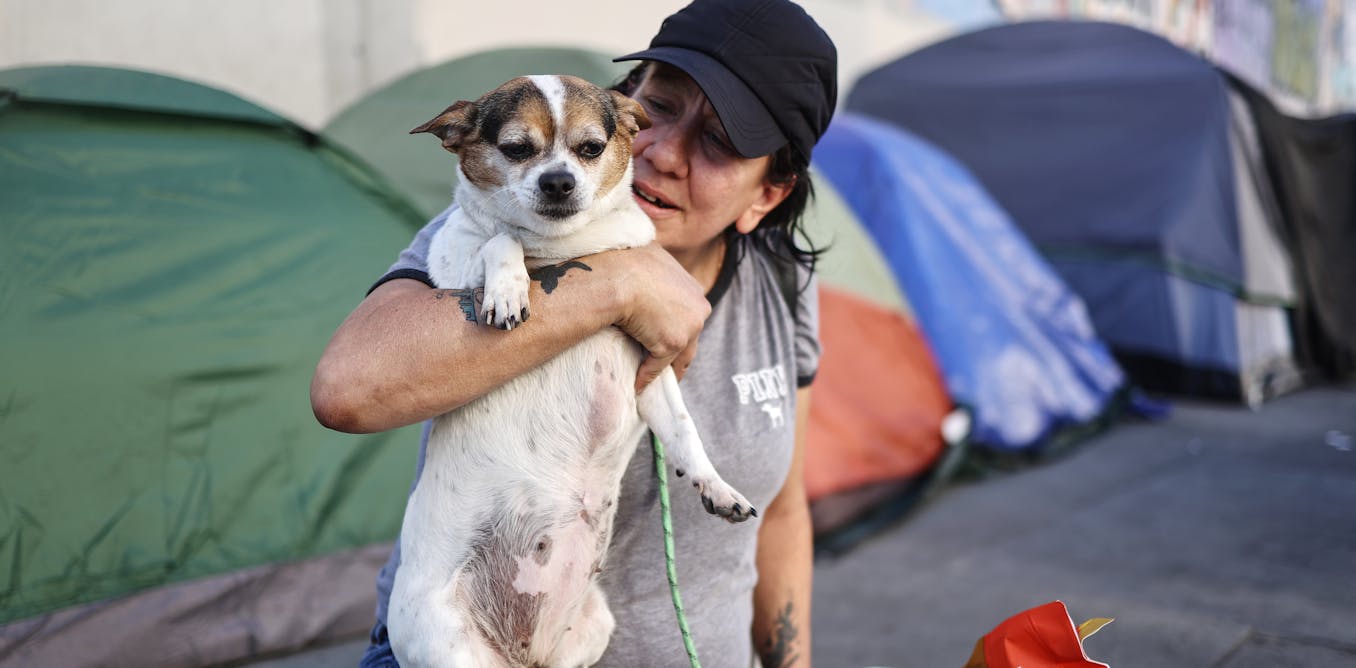
When homeless shelters allow people to stay with their dogs and other pets, more unhoused people become more willing to stay in a shelter.
That’s what my team at the University of Southern California’s Homelessness Policy Research Institute learned when we evaluated California’s Pet Assistance and Support Program.
California’s Department of Housing and Community Development established this pilot program in 2019. Its goals were straightforward: to make homeless shelters more accommodating to people with pets – mostly dogs – so that people living on the streets don’t have to choose between staying in shelters or abandoning their pets.
The program disbursed US$15.75 million between 2020 and 2024 to 37 organizations across the state. The funding allowed shelters to build kennels or other pet-friendly spaces, provide pet food and supplies, and offer basic veterinary care. It also covered the costs of staffing and maintaining insurance required to operate pet-friendly shelters.
Evaluating the program
We did this evaluation in collaboration with My Dog Is My Home, a nonprofit that supports pet-inclusive housing and services for the homeless, and the American Society for the Prevention of Cruelty to Animals.
By all accounts, the program was a success.
We found that the program helped 4,407 people experiencing homelessness keep their pets while getting support. Many were able to enter shelters, and their animals received needed veterinary care. A total of 886 people ultimately moved into permanent housing with their pets – a higher success rate than the statewide average for homeless people in California.
Theoretically, this funding should have reduced the number of pet owners living on the streets. Yet since 2019, the year the program began, the number of homeless people in Los Angeles with dogs and other pets has increased.
Qian Weizhong/VCG via Getty Images
I’ve seen this change firsthand.
Since 2017, I’ve led the USC research team that produces the annual homeless count estimates for Los Angeles. The U.S. Department of Housing and Urban Development requires this exercise for any city seeking federal funding for homelessness services.
One of the questions my team asks when interviewing thousands of homeless people each year is whether they have any pets.
Before the pandemic, we generally found that roughly 1 in 8 people did. We also found that nearly half of homeless pet owners had been turned away from a homeless shelter because it couldn’t accommodate their animal.
Despite programs like California’s Pet Assistance and Support program, my research team has found that the share of people living on the streets of Los Angeles who say they have a pet increased to roughly 1 in 5 by 2025.
Need for more pet-friendly programs
We still don’t know why the share of homeless people with pets has gotten so much larger.
It could be that rising housing costs, which is the main driver of homelessness, is pushing more pet owners into homelessness. Or, perhaps more homeless are adopting pets to deal with their social isolation and loneliness, two common conditions for people with nowhere to go.

Grace Hie Yoon/Anadolu via Getty Images
Either way, proposed cuts by the federal government to affordable housing and homeless services will only make matters worse.
The number of homeless people in Los Angeles has fallen by more than 4% since 2023 to just over 72,000 people in 2025. But based on my research findings, I would expect the number of people living on the city’s streets – with and without pets – to rise over time unless more affordable housing becomes available.
And growth in the homeless population may be hard to avoid without more efforts like California’s Pet Assistance and Support Program – on a larger scale than the pilot we studied.