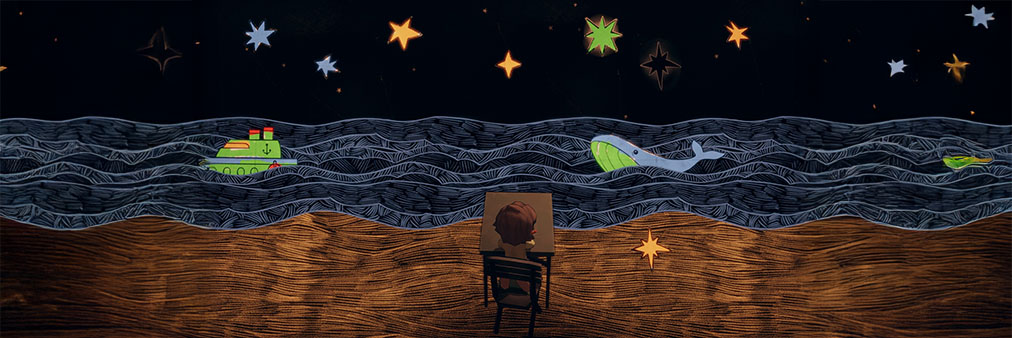
What does war look like through the eyes of a child? For those far removed from conflict, it can be hard to imagine. A new narrative adventure game, We Grew Up in War, sets out to answer that question through the stories of Mak, Anna, Valerie and Melisa.
Co-developed by Prague-based studio Charles Games and the War Childhood Museum in Sarajevo, the game draws on real testimonies from children who grew up in conflict.
The museum, founded in the aftermath of Bosnia’s 1992–95 war, is building one of the world’s largest archives on wartime childhood. The institution is part of Sites of Conscience, a global network of organisations that confront difficult pasts to foster dialogue.
The game reflects that work, offering a record of events, but also a window into how war feels from a child’s perspective.
We Grew Up in War is not a conventional game: there is no scoring, advancing or winning. It draws on the real experiences of children growing up in conflict zones, with a focus on Bosnia and Ukraine, using immersive wartime sketches to bring their stories to life and foster empathy and awareness among players.
This approach is part of a broader EU-funded research effort known as MEMENTOES, where museums, historians and game developers explore how video games can tell difficult stories from the past and reach audiences beyond traditional exhibitions.
They use virtual reality and other immersive techniques to make painful histories more tangible for players.
“The game is not only about suffering or portraying survivors as victims,” said Jasminko Halilović, founder and director of the Sarajevo museum, which focuses on childhood experiences in wartime. “It is also about family life, friendships, education, and having dreams and hopes.”
A new way to tell old stories
Museums have long grappled with how to communicate complex and often traumatic histories. Through the MEMENTOES collaboration, researchers from Austria, Belgium, Czechia, Greece, Ireland and the Netherlands set out to test whether video games could provide a new way of reaching a wider – and younger – audience.
“
Games are a great tool to make cultural heritage tangible, accessible and memorable to the public.
We Grew Up in War is one of several titles developed by the MEMENTOES team, which brought together curators, researchers and game designers.
Project coordinator Nikolaos Dimitriou, a senior researcher at the Centre for Research & Technology Hellas (CERTH) in Thessaloniki, Greece, was a bit sceptical at first, but intrigued by the idea of interactive storytelling.
“When I was younger, I played video games just for fun,” he said. “At some point I thought I was spending too much time on them. But this is different. It’s like taking a history class, but in a more engaging way.”
Stepping into the past
Alongside We Grew Up in War, the MEMENTOES team produced two other very different game experiences. One of them, Those From Below, uses virtual reality to revisit the 1956 mining disaster in Marcinelle, Belgium.
Developed with Causa Creations, alongside input from the Le Bois du Cazier museum in Marcinelle, another Site of Conscience in the network, and relatives of the victims, it places players inside the coal mine, confronting them with the harsh realities faced by the miners.
Another game, Gulag Diaries, takes players to Soviet-era forced labour camps in Siberia.
It was developed by researchers at the Institute of Computer Science of the Foundation for Research & Technology – Hellas (ICS-FORTH), in collaboration with Gulag.cz, a Czech-based research and educational initiative that documents the history of the labour camps (gulags) through expeditions, survivor testimonies and digital reconstructions.
Based on a real-life expedition and historical data from Gulag.cz, the game follows a researcher on a trip into the Siberian wilderness to explore the remains of a fictional Gulag, connecting players with the experiences of victims.
“The player finds objects left behind by the prisoners,” said Stavroula Ntoa, who led the scientific work of the project. “Each item reveals a personal story, helping players understand what life was like in these camps.”
Walking a thin line
Using games to explore sensitive historical topics comes with its own challenges. Unlike traditional exhibits, games are interactive, and that raises questions about tone, accuracy and respect. It can be a very fine line to tread.
“What we try to do in the game is the same as in our exhibitions: show how complex these experiences are,” said Halilović. But striking the right balance is not always easy.
“One of the challenges was not to ‘gamify’ the experience too much,” Ntoa said. “The goal wasn’t to make it fun. It was to make it engaging and a valuable learning experience.”
Achieving that balance required close collaboration between developers, historians and the people whose stories inspired the games.
“When you use real testimonies, they are unique and can become identifiable,” Halilović explained. “We worked closely with contributors to ensure they were comfortable with how their stories were presented.”
More than just information
The games engage visitors and bring historical injustices into focus. “Games are a great tool to make cultural heritage tangible, accessible and memorable to the public,” said Dimitriou.
But their real strength may lie in building empathy – by putting players in someone else’s shoes and letting them experience events from the inside.
“
Thanks to the game, people anywhere in the world can now engage with our collection.
“If players can understand the layered consequences of war for children, we also hope that it helps them appreciate the importance of peace,” Halilović said.
Early findings suggest that this approach can have a real impact. In some cases, researchers found that engaging secondary school students in We Grew Up in War could change their attitudes towards refugees.
And the lessons learned are not confined to the past.
“These issues are not just historical,” Dimitriou said. “Children are still growing up in war zones today. Helping people relate to those experiences is very important.”
Beyond the museum visit
Although the research collaboration behind these games wrapped up in 2025, the work is far from over. We Grew Up in War is set for wider release, including an educational edition and a commercial version on the Steam video game platform.
For Halilović, the potential goes well beyond a single project.
“Thanks to the game, people anywhere in the world can now engage with our collection,” he said. “That was not possible before.”
As museums look for new ways to connect with audiences, digital tools are becoming increasingly important, in line with efforts across Europe to digitise cultural heritage and make it more widely accessible.
Games are starting to play a key role in that shift, especially when they draw on immersive technologies and rich digital archives to carry the museums’ messages into players’ homes and classrooms.
“They allow us to extend our stories beyond museum walls,” Halilović said. “And to reach people who might never otherwise walk through our doors.”
Research in this article was funded by the EU’s Horizon Programme. The views of the interviewees don’t necessarily reflect those of the European Commission. If you liked this article, please consider sharing it on social media.