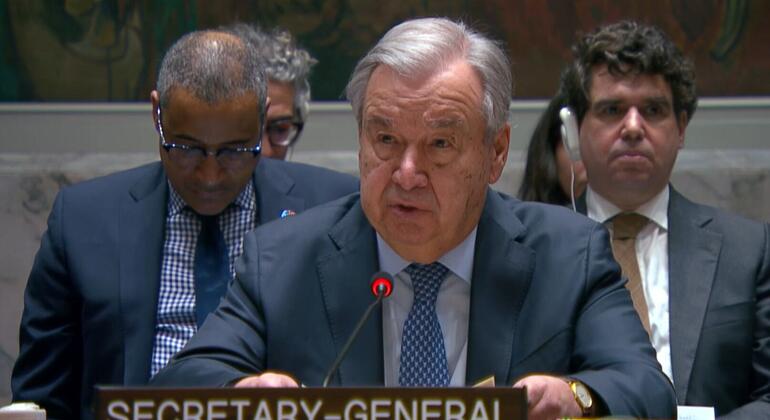
António Guterres described the day’s events as a grave threat to international peace and security, urging the international community to unite and pull the entire region “back from the brink”.
Mr. Guterres reminded the council that Article Two of the UN Charter states that all Member States “shall refrain in their international relations from the threat or use of force against the territorial integrity or political independence of any State,” and that international law and international humanitarian law must always be respected.
The military action that has embroiled countries across the Middle East, continued the UN chief, carries the risk of “igniting a chain of events that no one can control in the most volatile region of the world.”
Diplomats gather at the UN Security Council to discuss the fast-evolving crisis in Iran and the whole Middle East region.
‘Return to the negotiating table’
The Secretary-General reiterated that lasting peace can only be achieved through peaceful means, including genuine dialogue and negotiations, and noted that the joint military operation by Israel and the United States occurred following indirect talks between the US and Iran mediated by Oman, “squandering” an opportunity for diplomacy.
Calling for de-escalation and an immediate cessation of hostilities, Mr. Guterres strongly urged all parties to return immediately to the negotiating table, notably on the future of Iran’s nuclear programme.
“I call on all Member States to strictly uphold their obligations under international law, including the UN Charter, to respect and protect civilians in accordance with international humanitarian law, and to ensure nuclear safety,” he declared.
France: ‘We need Iran to respect its international obligations’
Jérôme Bonnafont of France called for Iran to respect its international obligations, stressing that adherence to international law is “a condition for long-term security in the region and world.”
Ambassador Bonnafont said that Iran has not taken the opportunity to conclude a nuclear agreement but has instead reduced its cooperation with the International Atomic Energy Agency (IAEA).
Russia: ‘Another unprovoked act of armed aggression’
Russian Ambassador Vassily Nebenzia said that the US-Israeli strikes were “yet another unprovoked act of armed aggression against a sovereign and independent Member State, in violation of the UN Charter and international law.”
This “reckless step,” he said, has led to a sharp escalation across the region, which he described as a “betrayal of diplomacy”.
China: Territorial integrity of Iran ‘must be respected’
China’s Ambassador Fu Cong described the US-Israeli strikes as “brazen”, condemning the threat of force to settle any international dispute – and calling for the “sovereignty, security, and territorial integrity of Iran and other regional countries to be respected.”
Expressing sadness at the large loss of civilian life during Saturday’s strikes, Ambassador Fu called on all parties to fulfil their obligations under international law and an immediate cessation of military action.
He said it was “shocking” that the US-Israeli attacks had come in the middle of diplomatic negotiations between the US and Iran.
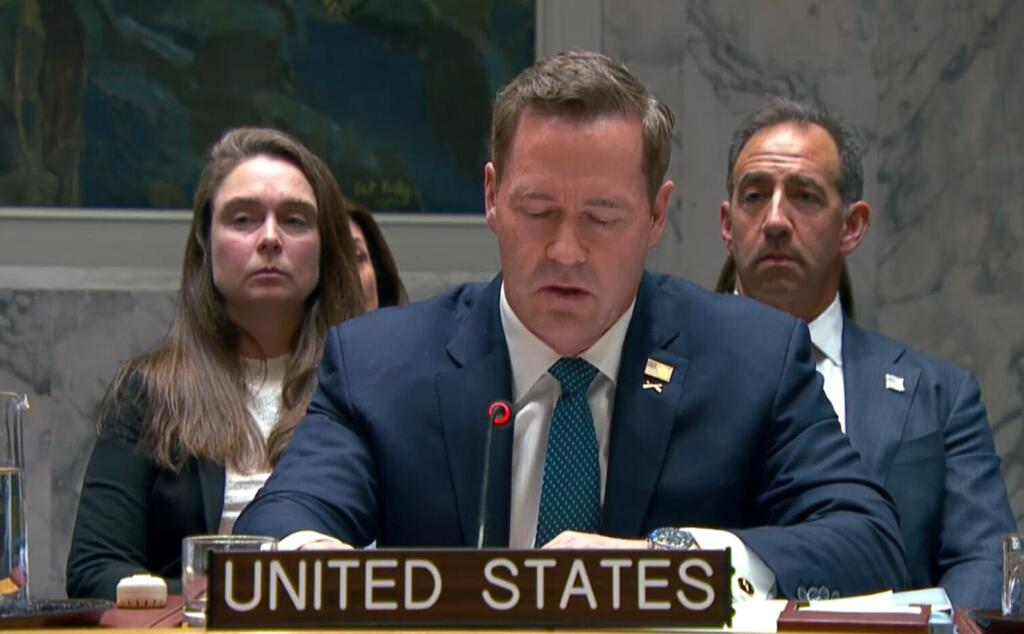
Ambassador Mike Waltz of the United States addresses the Security Council meeting on Iran and the Middle East.
United States: ‘Persistent aggression’ could not be ignored
Ambassador Mike Waltz of the United States said that the strikes on Iran were directed towards dismantling its ballistic missile capabilities, degrading naval assets being used to destabilise international waters and disrupt the machinery that arms proxy militias.
The aim, he continued, is to ensure that “the Iranian regime can never, ever threaten the world with a nuclear weapon.”
“No responsible nation can ignore persistent aggression and violence.” he warned, adding that Iran’s continued pursuit of advanced missile capabilities, coupled with its refusal to abandon nuclear ambitions – despite diplomatic opportunities – represents “a grave and mounting danger”.
UK: Regional stability ‘a priority’
“This is a fragile moment for the Middle East,” said Ambassador James Kariuki of the United Kingdom, Council President for February. “Regional stability remains a priority,” he said, adding that UK forces are active and its planes are in the sky as part of “coordinated regional defensive operations”, in line with international law.
“We want to see the swiftest possible resolution that ensures security and stability for the region,” he continued, urging Iran to refrain from further strikes and its “appalling” behaviour to allow a path back to diplomacy.
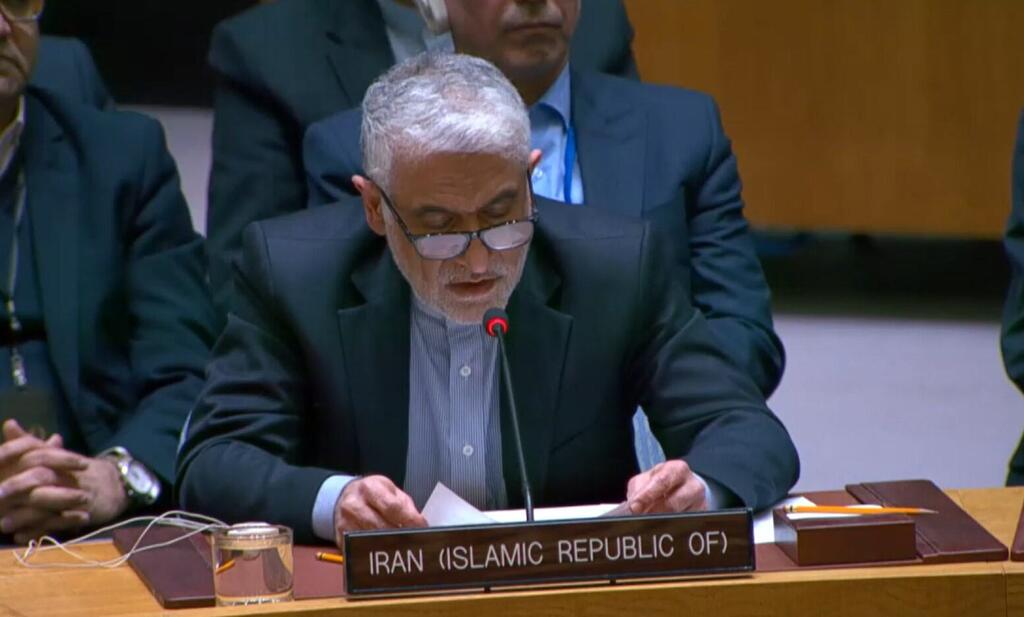
Iran’s Ambassador Amir Saeid Iravani address the Security Council.
Iran: Strikes ‘devoid of legal foundation’
“This morning, the United States regime – jointly and in coordination with the Israeli regime – initiated an unprovoked and premeditated aggression against the Islamic Republic of Iran for the second time in recent months,” said Iran’s Ambassador Amir Saeid Iravani.
“This is not only an act of aggression; it is a war crime and a crime against humanity,” he insisted, accusing the US and Israel of deliberately attacking civilian populated areas in multiple large cities.
“The invocation to ‘pre-emptive attack,’ claims of imminent threat, or other unsubstantiated political claims, are unfounded legally, morally and politically,” Mr. Iravani continued, categorically rejecting the assertions made by the representatives of France, the UK and other Western representatives regarding Iran’s peaceful nuclear programme.
Israel: Attacks ‘an act of necessity’
Israel’s strikes on Iran, said Ambassador Danny Danon, took place to stop “an existential threat before it became irreversible.”
His country had acted out of necessity because the regime left no reasonable alternative, building nuclear weapons in disregard for international law, murdering its own citizens and crushing dissent, expanding missile arsenals and arming proxies across the region – all while declaring its intention to erase Israel from the map.
Ambassador Danon said Tehran had been required to stop enriching uranium and to allow full inspections but did not do so.
“They were building the means to force an irreversible reality with our backs against the wall. That is not a future Israel will accept.”
Catch up with all of Saturday’s main events inside the chamber and beyond from our UN News and Meetings Coverage team, here.