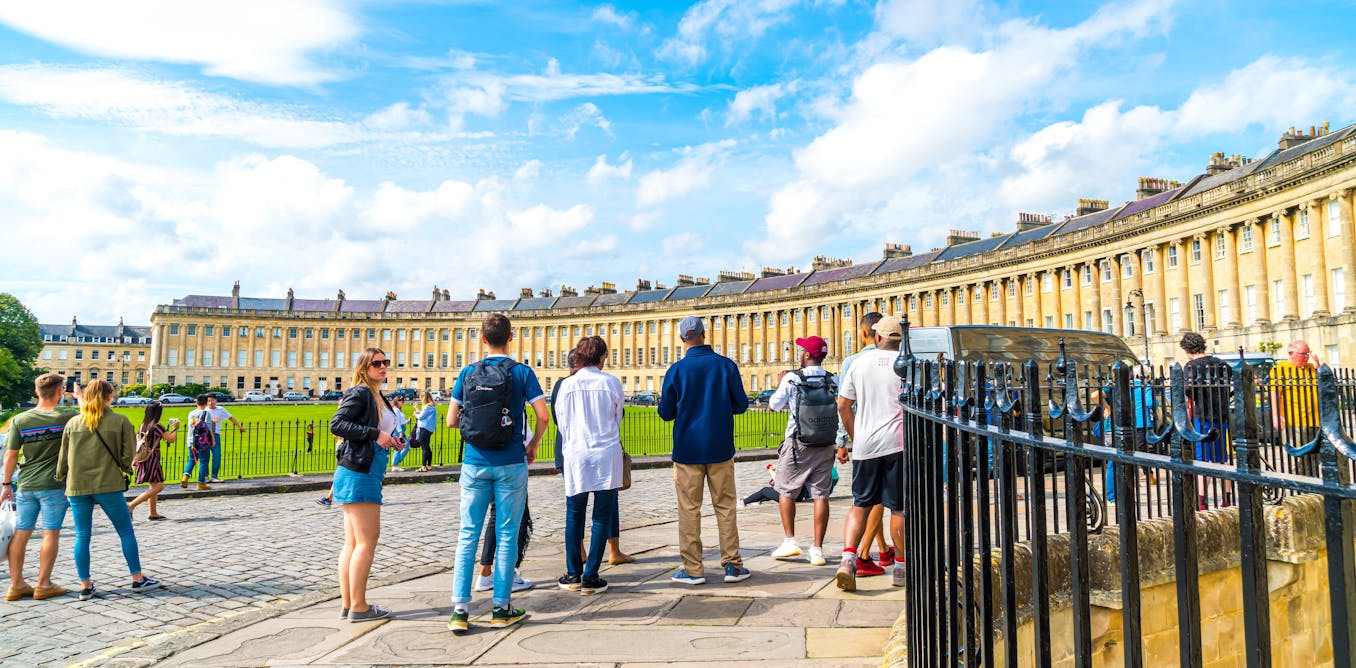
Some buildings leave such an impression when you visit them that they can be forever summoned to the mind’s eye. For us, these include the soaring dome of St Paul’s cathedral in London, the Georgian grandeur of Royal Crescent in Bath, and the ascending towers and pinnacles of King’s College Chapel in Cambridge.
As psychologists with a particular focus on wellbeing, we are fascinated by the feelings these buildings instil in us – a sense of being grounded, of momentary stillness, even of awe.
But while the effects of experiencing beautiful surroundings on people’s wellbeing has been extensively researched, these studies have mainly focused on natural landscapes and settings.
We wanted to understand how people value different urban settings – and which types of building they view most positively. In England, 83 out of every 100 people now live in towns and cities, so variations in these urban landscapes can hold important consequences for wellbeing.
Our study, published in Frontiers in Psychology, found a particularly powerful effect when people viewed older buildings, particularly those classified as being of special historic or architectural interest. Indeed, we found these listed buildings are comparable with forests and lakes in terms of how people rated their scenic quality.
How we tested urban scenicness
Our study combined two large datasets – the first from Scenic-Or-Not, a website where people rate the scenicness of photographs taken throughout Britain on a scale from 1 (“not scenic”) to 10 (“very scenic”). For our analysis, we used only photographs taken within English urban areas, giving us 28,547 ratings of 3,843 images.
We combined this with Historic England’s dataset of more than 370,000 listed buildings throughout England and Wales, plus their grade – I (of exceptional interest), II* (particularly important) or II (special interest) – and the century in which the building was constructed.

B Hilton
This enabled us to compare the ratings of views with and without listed buildings, and to explore other questions such as how the grade or century of construction influences the scenicness rating. Sometimes these buildings featured prominently in the photographs, other times only marginally – we counted them all the same.
We also used Google’s Vision AI tool to detect other features in photographs that might influence scenicness. This allowed us to rule out the possibility that photographs containing historic buildings were judged more scenic because they also tended to contain trees, for example.
In our study, the average scenicness of English urban areas was 2.43 out of 10 – significantly lower than how people rate the scenicness of natural environments. In another study that used the same platform to rate British rural scenes, these averaged 4.16.
But we also found that when a listed building was present in the photograph, this score was on average 0.61 points higher – a 25% increase. As shown in this table, this “historic building effect” was comparable to that of forests and lakes.
Impact of different features on scenicness rating:

Eugene Malthouse, CC BY-SA
Photographs in which the most prominent listed building was either grade I or grade II* listed were perceived more scenic than those featuring slightly less historically or architecturally significant (grade II) buildings. Images featuring buildings constructed in earlier centuries were also judged more scenic.
What makes historic buildings so valued?
The scenic quality of urban areas has previously been linked with variations in happiness and health. Our study shows old buildings in particular make important contributions to urban scenicness. This suggests that historic buildings may be worth preserving not only for their architectural significance but for their effect on people’s wellbeing.
But it also raises the question of whether the sheer age of these buildings makes them so impactful – or is it also the nature of their design?
Experts in architecture have speculated on the reasons old buildings continue to be valued so highly. For example, the apparent timeless popularity of certain historic styles, such as the symmetry of Georgian architecture in Bath’s Royal Crescent, has been contrasted with modern architecture that disregards or rejects traditional proportional guidelines.
But there are also psychological reasons why many people value historic buildings so much. These might include their reassuring sense of permanence; their weathered and imperfect nature; the stories of past lives they hold; or their ability to conjure feelings of nostalgia within us.
We hope to learn more about why people feel so strongly about historic buildings, and the effects such buildings can have on their wellbeing, in our future research. In the meantime, please share your thoughts and experiences in the comments below.

Eugene Malthouse received funding from the European Research Council.
Sidney Sherborne received funding from the European Research Council.