EDINBURGH — In a breakthrough that could fundamentally “defossilize” the multi-billion dollar chemical industry, researchers at the University of Edinburgh have successfully used waste bread to replace fossil fuels in a critical manufacturing process. The study, published this week in Nature Chemistry, demonstrates a microbial method for hydrogenation—a reaction essential to the production of everything from life-saving pharmaceuticals to everyday food fats and plastics.
Traditionally, hydrogenation requires hydrogen gas derived from natural gas or coal, processed under extreme temperatures and “ocean-floor” pressures. By contrast, the Edinburgh team, led by Professor Stephen Wallace, utilized the natural metabolism of E. coli bacteria to generate hydrogen directly from the sugars found in discarded bread.
The “One-Pot” Microbial Engine
The innovation lies in its elegant simplicity. By placing common lab bacteria, bread scraps, and a target chemical into a single, oxygen-free vessel at room temperature, the researchers created a self-sustaining chemical factory.
- Waste as Fuel: The system feeds on Britain’s estimated 900,000 tonnes of annual bread waste, diverting it from landfills where it would otherwise emit potent methane gas.
- Carbon-Negative Impact: A comprehensive life-cycle analysis revealed that the process removes more greenhouse gases than it produces. By avoiding fossil-fuel inputs and sequestering carbon from food waste, the method achieves a rare “net-positive” environmental profile.
- Energy Efficiency: Unlike industrial hydrogenation, which demands massive energy loads to maintain heat and pressure, the microbial approach operates at near-ambient conditions, drastically reducing the carbon footprint of the final product.
Scaling the “Green Revolution”
The implications for global manufacturing are vast. Hydrogenation is a cornerstone of the pharmaceutical sector, underpinning roughly 14% of all drug synthesis. “Being able to run these reactions using microbial hydrogen opens up new possibilities for sustainable manufacturing at scale,” said Professor Wallace.
The breakthrough is part of a larger £14 million “Carbon-Loop” hub aimed at transforming the UK’s industrial waste into high-value materials. Already, industry partners and biotech firms like MiAlgae are eyeing the technology as a blueprint for a circular economy where “waste” no longer exists as a concept.
As the University of Edinburgh pushes toward its goal of becoming carbon neutral by 2040, the humble breadcrumb has emerged as an unlikely hero in the race to decouple modern chemistry from its fossil-fuel past.
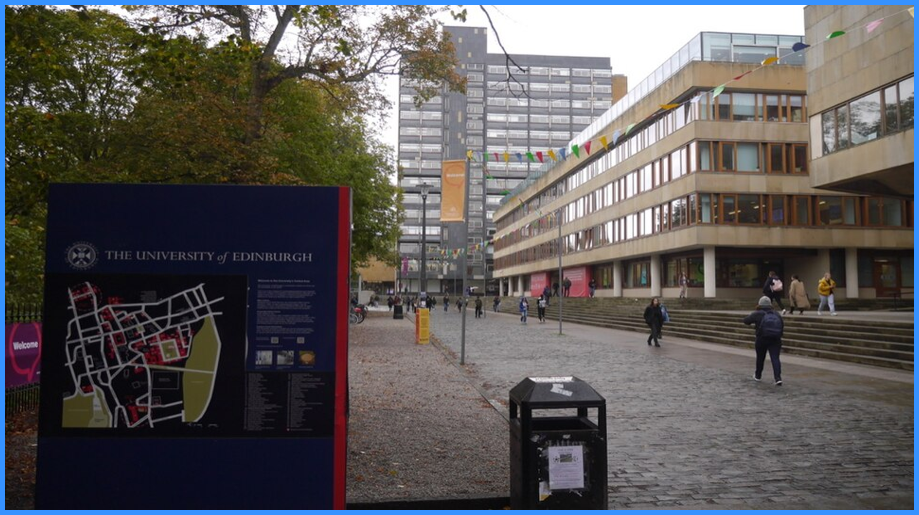
University of Edinburgh, George Square by Richard Webb