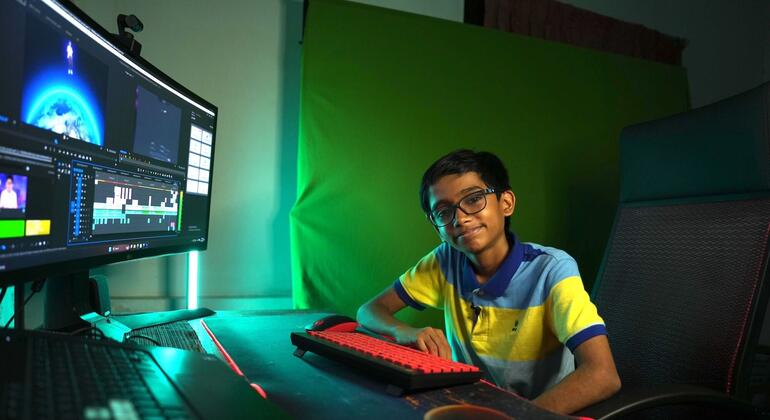
At the recent India AI summit, Raul told UN News what drives his passion for the technology, and why we need to fully embrace it.
Largely self-taught, Raul built his first robot at the age of 12 and has developed over 10 AI tools. He has advised the Kerala and Dubai governments on how to integrate AI into public services and is the founder of AI Realm Technologies.
Raul’s achievements have led to speaking engagements at major technology companies, and invitations to international conferences, such as last week’s 2026 India AI Summit in New Delhi, where he was introduced to Amandeep Gill, the UN Special Envoy for Digital and Emerging Technologies, as well as UN Secretary-General António Guterres.
After a UN-organised panel discussion on AI and children’s safety, at which he delivered the opening address, Raul sat down with Anshu Sharma from UN News to talk about his business journey, hopes for the future and how young people should best engage with AI.
This interview has been edited for clarity and length
UN News: Why did you get interested in technology?
Raul John Aju: I discovered technology through video editing. When my father got a job at Adobe I got free access to all the premium tools and I was able to learn about AI. After that I created my robot [known as MeBot, built for a school science project].
“AI Kid of India,” Raul John Aju, with United Nations Under-Secretary-General and Special Envoy for Digital and Emerging Technologies, Amandeep Singh Gill, after an ODET side session at the AI Impact Summit 2026 in India.
UN News: How did you come to start your own company?
Raul John Aju: The main reason was I wanted all of the tools that I had built to be under one brand name. I also wanted to create a payment system to make people’s lives easier, so that they can just use a QR code to pay for things, if they don’t have a credit or debit card.
UN News: Tell me about some of your AI innovations.
Raul John Aju: One of them is the Rescue AI tool. The idea is that, if you’re involved in an emergency situation, the tool will tell you what to do, and which laws apply. It will connect you with a lawyer and also help the lawyer to craft a strategy to win the case, by looking at thousands of similar cases.
Another project is ThinkCraft Academy, where you can go from learning about AI to building your own tools to use in daily life. The courses are free, and more than seven million people have been able to learn from them.
UN News: Your decision to hire your own father garnered a lot of attention. What was the thinking behind that?
Raul John Aju: I can gain as much knowledge as I want from my phone, but I don’t have his experience. He has worked for companies like Amazon, Adobe, Wipro, and IBM, so I can learn from him. Also, to be honest, it was good for my marketing!
UN News: You’ve taught a lot of students. What has that experience been like?
Raul John Aju: I tell them that I want all of them to start using AI but at the same time not forget the human inside them. I always say that the most important skill in the world of AI is to be as human as possible.
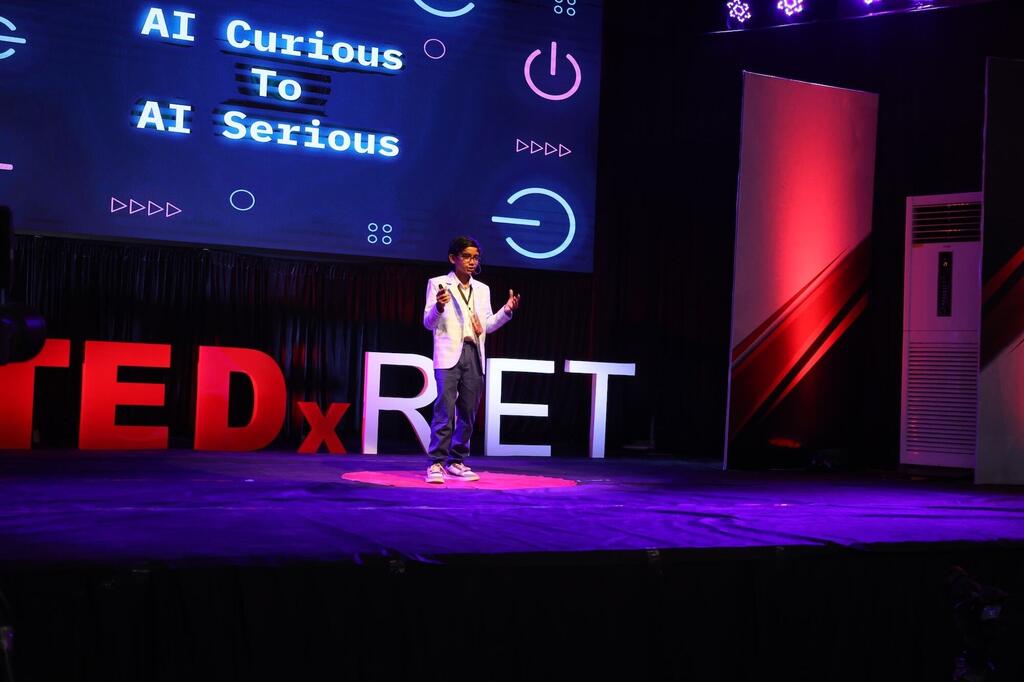
Raul John Aju at a TEDx event.
UN News: Where do you see yourself in the next 10 years?
I do want to have enough money to be able to get whatever I want for my parents or for myself. At the same time, I want my tools to make daily life easier for people. I also want to spend time in the West and keep on learning.
UN News: How would you sum up your journey so far?
Raul John Aju: I guess I would say two things. First of all, be humble or the world will humble you. Second, follow your passion, not money, because if you follow your passion, the money will automatically come.