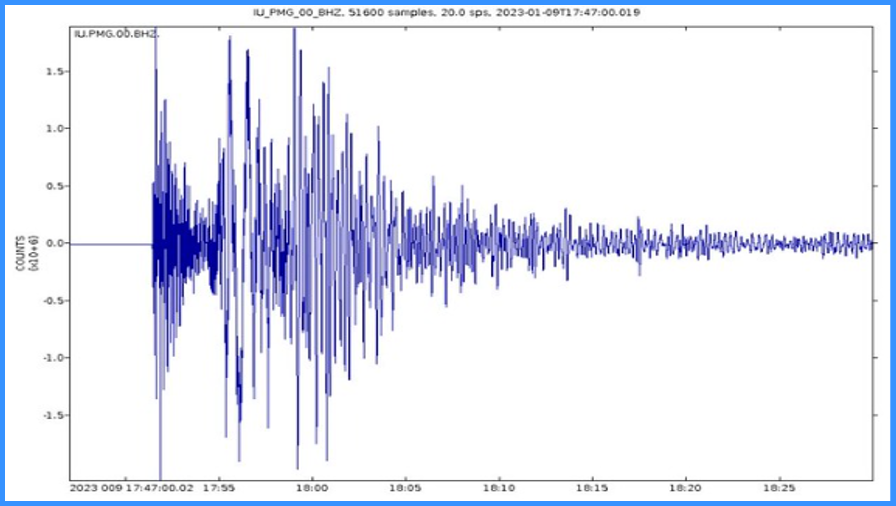
KABUL — A powerful earthquake struck the rugged Hindu Kush mountain range on Friday afternoon, sending tremors through the Afghan capital and across the border into neighboring Pakistan. The GFZ German Research Centre for Geosciences recorded the seismic event at a magnitude of 5.7, striking at 5:39 p.m. local time (13:09 GMT).
The timing was particularly sensitive for the local population; the quake hit just as residents across the Muslim-majority nation were preparing for Iftar, the meal to break the daily Ramadan fast.
Seismic Specifics: Depth and Distance
The earthquake originated at a significant depth—initially measured by GFZ at 79 kilometers (49 miles)—approximately 130 kilometers northeast of Kabul. This depth likely mitigated the potential for catastrophic surface destruction, though the intensity was felt acutely across the region.
- Epicenter: Initially determined to be in the Panjshir province, near several remote mountainous villages.
- Regional Impact: Beyond Kabul, residents in the provinces of Nangarhar, Bamiyan, and Wardak reported strong vibrations lasting roughly 30 seconds.
- Cross-Border Reach: In Pakistan, tremors prompted residents in Islamabad, Peshawar, and parts of the Khyber Pakhtunkhwa province to rush out of their homes in a state of panic.
The Aftermath: “Minor Damage” and Local Fear
Early reports from the Panjshir Natural Disaster Management agency suggest that while the force was “very strong,” the immediate fallout appears limited. Local officials noted “minor damage,” such as cracks in the walls of shoddily built homes, but as of Friday evening, there were no confirmed reports of casualties or structural collapses.
However, the psychological toll in the Hindu Kush remains high. “Everyone was horrified,” Zilgay Talabi, a resident of the Khenj district near the epicenter, told reporters. “We fear that landslides and avalanches may follow in these mountains.”
A Region Under Constant Pressure
Afghanistan remains one of the most seismically volatile regions in the world, positioned where the Eurasian and Indian tectonic plates collide. This latest tremor follows a devastating legacy of seismic activity:
- August 2025: A shallow 6.0-magnitude quake in eastern Afghanistan killed more than 2,200 people.
- Late 2023: A series of 6.3-magnitude quakes in Herat killed hundreds and leveled thousands of homes.
Humanitarian and Infrastructure Hurdles
The challenge for the administration in Kabul now lies in communication. Afghanistan’s mountainous terrain and aging infrastructure often delay damage assessments by days. As of late Friday, emergency teams are still attempting to reach far-flung villages to ensure no one remains trapped beneath the rubble of rural dwellings.
With Ramadan underway, the focus has shifted to ensuring that the power and water infrastructure—which saw brief outages in parts of Kabul during the quake—remains stable for the duration of the holy month.
Earthquake Richter Scale Picture by James St. John