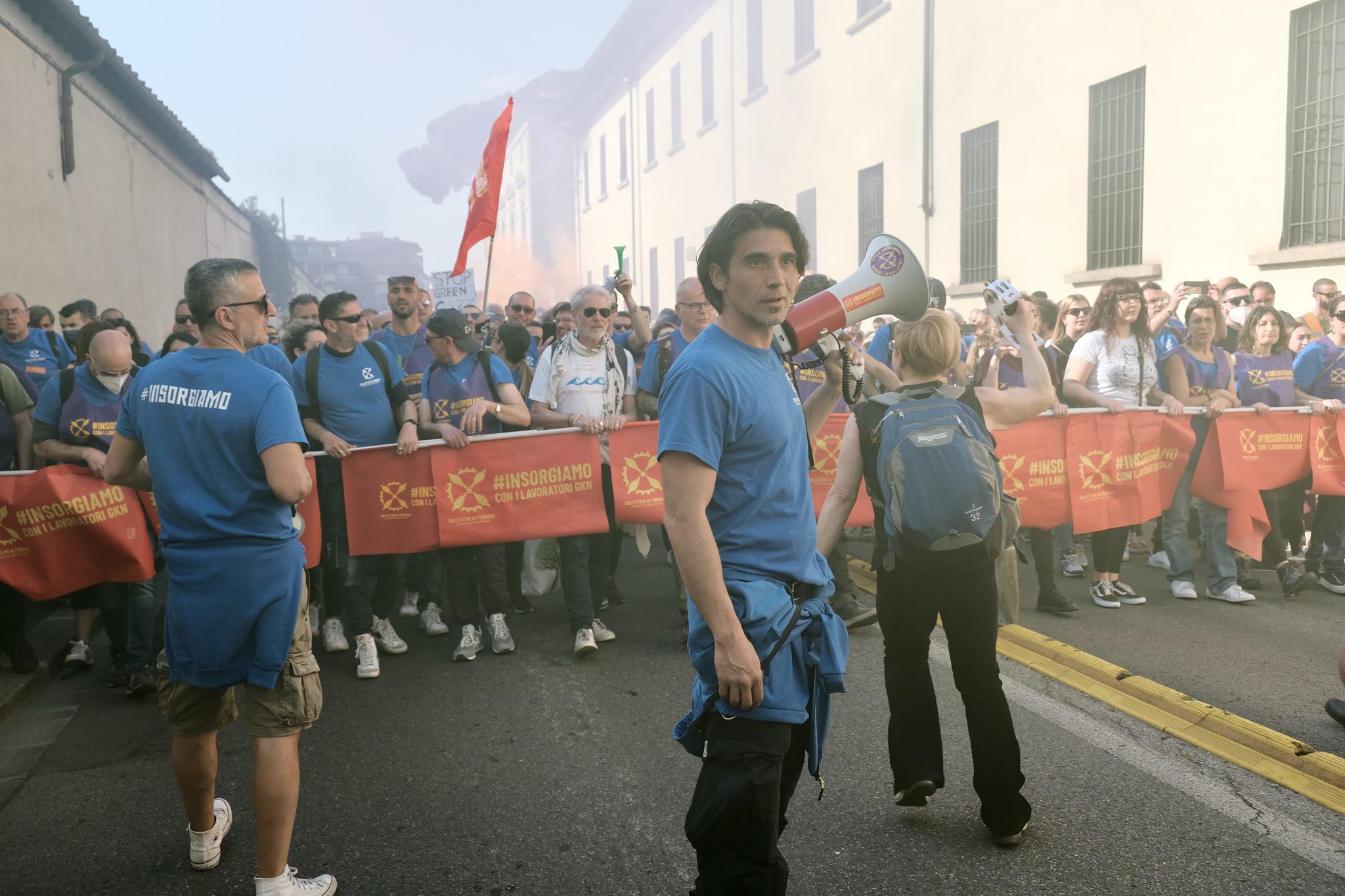
In the summer of 2021, the GKN auto parts factory near the Italian city of Florence was closed, and over 400 workers lost their jobs. Since then, some of them have been occupying the building—for over four years now. Their goal is to manufacture solar panels and electric cargo bikes, thereby converting the factory into an eco-friendly facility. As a cooperative, they are leading the longest workers‘ struggle in Italian history and showing that even in a globalized world, workers can fight back against mass layoffs and make a difference. They want to reach their investment goal with the help of crowdfunding.
Over 400 workers at an Italian car factory were simply dismissed by email
On July 9, 2021, the 422 workers at the GKN plant (which manufactured car parts on behalf of Stellantis) in Campi Bisenzio near Florence received an email. The content: a letter of dismissal. Two months later, a labor court in Florence ruled that these dismissals were unlawful because the obligation to inform the unions had not been fulfilled—in other words, the unions had not been adequately informed about the layoffs and should have been involved. Since then, some of the workers have been occupying the factory where auto parts were produced. And this despite unpaid wages – some have side jobs or are getting by on unemployment benefits or savings.
The eternal works meeting: Four years of permanent occupation
In a kind of permanent works council, the workers at the GKN factory take turns in eight-hour shifts. Under the name “Collettivo di Fabbrica,” they are fighting to keep their jobs and for the climate-friendly conversion of the factory. Their motto, “Insorgiamo” (Let’s rise up!), has its roots in the Italian partisan movement that fought against fascism.
“This (the factory) is our home. We’re not leaving here. And not a single screw will disappear from here.” – Dario Salvetti, spokesperson for the collective.
By occupying the factory, the collective is protecting its means of production (e.g., machines) and preventing them from being relocated abroad, where production would continue at low cost. This phenomenon is also familiar in Austria: in 2020, the Styrian electric motor manufacturer ATB relocated its production to the low-wage countries of Serbia and Poland. This is exactly what the factory collective in Italy wants to prevent. It hopes to resume its work in the factory as a cooperative (ex GKN For Future, GFF). They want to manage the factory together, make democratic decisions, and work for social benefit rather than profit.
Years of delaying tactics – workers should give up the fight
Currently, ownership of the factory is divided among three companies controlled by one person: Francesco Borgomeo, advisor to the Melrose financial fund. The closure of the plant is primarily attributable to Melrose. The industrial plan promised by Borgomeo never materialized. He simply tells the workers that he is not the investor and that he will introduce them to the new investor in a few months. For collective spokesperson Salvetti, the strategy is clear: Borgomeo is speculating with the property and the workers are being strung along until they give up the fight. But despite all the adversity, that is not an option for them. They have their own business plan, which they are already partially implementing.
Cargo bikes and solar panels: workers want to convert factory to climate-friendly production
The collective’s idea is to convert the factory’s production to be climate-friendly. In the future, solar panels and electric cargo bikes will be manufactured there. The plan was developed in collaboration with scientists in early 2023 and envisages employment for around 100 people. Organisations and non-profit banks have already pledged financial support to the collective. To reach its investment target of two million euros, the collective has also launched a crowdfunding campaign.
The collective is already implementing part of the business plan: workers are building the first cargo bikes in a small workshop on the outskirts of Florence. The main business will be photovoltaics, but there is a lack of space and resources for this. Due to legal disputes, they cannot use the premises in the factory.
https://www.instagram.com/p/C9kL_yjsPN2/?utm_source=ig_web_copy_link&igsh=NTc4MTIwNjQ2YQ==
The fight for protected jobs throughout Italy
The workers are concerned with preserving jobs that are well protected by law. This is because more and more companies in the region are being affected by closures and relocations to low-wage countries, where workers sometimes have little legal protection.
„We were fired in a cruel manner. But this is not just about our 500 jobs. Jobs across the country may be at stake. That’s why GKN is of national and political interest,“ says Dario Salvetti.
And the workers are not alone: many members of Tuscan civil society, a Europe-wide collective of scientists and students, and Fridays for Future are supporting the fight for an ecological conversion of the factory and the preservation of hundreds of jobs.

The site could be made available for public use thanks to legislation
At the end of June 2025, there was a dramatic turn of events: the tax court ruled that the factory site must be cleared. This would nip any new start for the factory in the bud and pave the way for real estate speculation. However, legislation passed in December 2024 gives cause for optimism: it allows municipalities and local authorities to take over the approximately 40,000 square metre site in order to make it available for public use. Specifically, state consortia for industrial development are to be created. The state could therefore buy the site immediately and make it available to start-ups – such as the collective. In theory, the owner could even be expropriated. Whether it will come to that is unclear.
What is a consortium?
A consortium is a temporary or project-based association of several independent actors—such as the state, banks, companies, or initiatives—who join forces for a specific project that would be too large or too risky to undertake alone. All remain legally independent but work together and share responsibilities and costs.
In the case of GKN, for example, a consortium would mean that the region, the municipality, perhaps public banks, and solidarity partners would jointly take over or finance the factory. The workers‘ cooperative could then use it and produce there. The consortium thus creates the structural and financial conditions—the cooperative organises the actual work and production.
Climate-friendly production instead of the arms industry: ex-GKN as a Europe-wide role model
The collective’s labour dispute has brought together people within Italy as well as individuals from a wide range of social movements and academics across Europe. In a small Basque town, a car manufacturer was closed down, and over a hundred workers were laid off. In addition to strikes, the unions – following the example of ex-GKN – have drawn up a plan for the socio-ecological restructuring of the company. At the VW plant in Osnabrück, which plans to stop building cars in 2027, workers are also mobilising together with people from civil society. Their goal is to convert the plant to climate-friendly mobility instead of producing tanks, as planned by the arms manufacturer Rheinmetall.
Lucas Plan: The idea of democratic transformation was born 50 years ago
The factory collective’s labour dispute is reminiscent of the Lucas Plan, which was published in 1976. The plan arose from a novel response by workers to mass layoffs. When the Lucas Aerospace Corporation laid off numerous workers due to international competition and restructuring, they drew up a plan for how they wanted to shape the company in the future. Their idea was to create something that would be of the greatest possible benefit to society. Among the numerous products proposed were medical devices such as dialysis machines and renewable energy sources such as heat pumps.
The plan was rejected by the government and management. But to this day, the Lucas Plan remains a model for all those who are committed to innovation for the good of society rather than for the high profits of private individuals.
The rights to the content remain with the original publisher.
Post Views: 27