Kai Shi, Xinjiang Institute of Ecology and Geography of the Chinese Academy of Sciences, discusses his article: CSR strategy shifts under biotic resistance and grazing drive invasion success of Solanum rostratum in northern China
Ecological theory offers two powerful explanations for why invasions should fail. Diverse native communities are expected to resist newcomers through competition, while harsh environments and disturbance should filter out species that lack the right traits. Yet, across many landscapes, certain invaders appear to ignore both rules.
We explored this paradox by investigating the invasion of Solanum rostratum across northern China. Rather than asking whether this species has a single “best” strategy, we focused on a different question: does flexibility in functional strategy help invaders overcome different ecological barriers across large spatial scales?
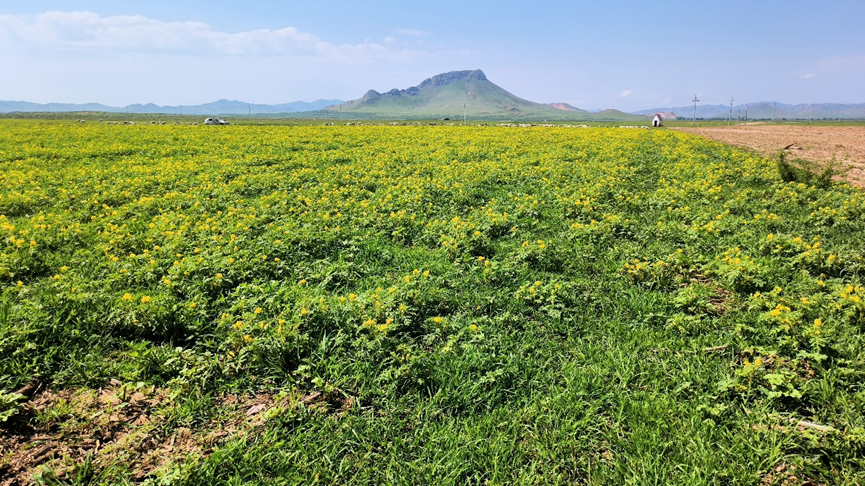
What we did: Following an invader across 3,000 kilometers
To answer this, we carried out a large field survey spanning 3,000 kilometers across northern China. Along this transect, grasslands differed markedly in climate, grazing pressure, and the structure of native plant communities.
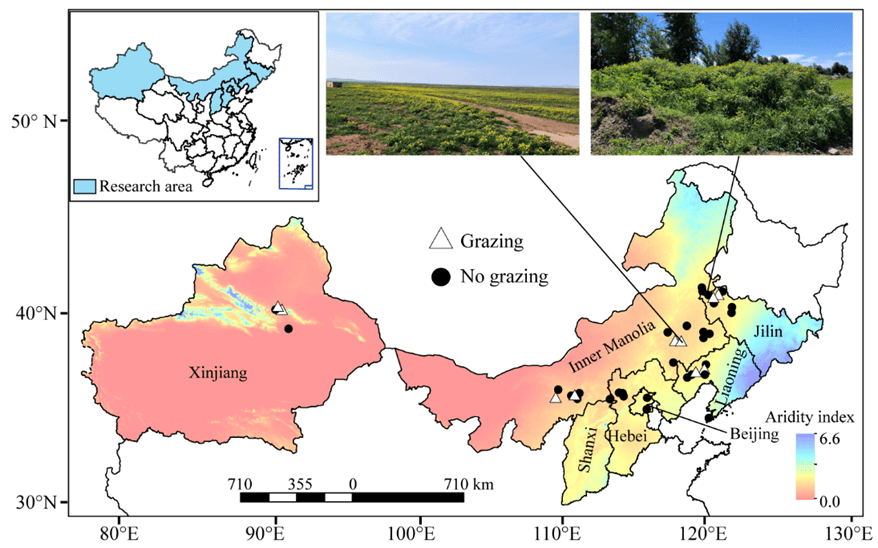
We described plant strategies using Grime’s CSR framework, which characterizes species along three axes—competition (C), stress tolerance (S), and ruderal strategy (R), reflecting adaptation to frequently disturbed environments. These strategies were inferred from key leaf functional traits (e.g. specific leaf area, leaf area, and leaf dry matter content) using a widely adopted trait-based approach. This framework allowed us to compare the invader’s strategy directly with that of the native communities it colonizes, and to track how these relationships change across environmental and biotic gradients. Rather than treating invasion as a simple presence–absence problem, we focused on strategy differences between the invader and native species, asking when and where these differences become largest—and why.
Key finding 1: A stable competitive core, with flexible edges
One pattern was strikingly consistent. Across all sites, S. rostratum invested more in competitive (C) strategy than native species. Its competitive advantage was evident not only relative to community averages, but also when compared with dominant native plants. This suggests that strong competition is a stable core feature of its invasion success.
At the same time, the invader was far from inflexible. While its C strategy remained relatively constant, its position along the stress-tolerant (S) and ruderal (R) axes shifted markedly across sites. Importantly, these shifts were closely linked to the functional composition of native communities rather than to climate alone.
Where native communities were richer in ruderal traits, S. rostratum reduced its own investment in competition and disturbance response, shifting instead towards greater stress tolerance. This pattern is consistent with a strategy of functional differentiation, allowing the invader to persist without directly overlapping with native competitors.
Grazing played a key role in shaping these dynamics. Rather than acting as a simple environmental filter, grazing altered native diversity and community strategies, indirectly influencing how the invader adjusted its own CSR profile.
Key finding 2: When strategy differences predict invasion success
Crucially, invasion intensity was tightly linked to how different the invader’s strategy was from that of native communities.
Greater divergence along the stress-tolerance axis was associated with higher invasion success, while divergence in ruderal strategies showed the opposite pattern. Along invasion gradients, S. rostratum increasingly strengthened its stress-tolerant strategy, whereas native communities shifted towards more ruderal traits. This contrasting response highlights a form of functional mismatch between invader and residents that appears to facilitate dominance.
Taken together, these results point to a dynamic process in which invasion success emerges not from a fixed strategy, but from context-dependent adjustment around a stable competitive core.
Why this matters for invasion ecology
Our study adds to a growing body of evidence that invasion success cannot be explained by single traits or universal strategies. Instead, it emerges from interactions between invader flexibility, native community structure, and disturbance regimes.
By showing how CSR strategies shift across large spatial scales, we highlight a process of strategy–environment matching that allows invaders to bypass both biotic resistance and environmental constraints. As grazing pressure and land use continue to intensify worldwide, understanding these functional adjustments will be essential for predicting—and managing—future plant invasions.