A better understanding of what happens belowground when restoring coastal vegetation may be useful to better plan restoration. However, little is known about what happens belowground when invasive species are controlled in restoration settings.
My students and I used a protected area of sandy coastal vegetation in an island in Southern Brazil as a model to investigate belowground dynamics in plant communities under restoration. These areas have been invaded by pine trees and controlling them is a key restoration strategy.
We collected 90 soil samples in invaded and non-invaded areas, and areas where pine trees were cut out. With these we obtained information on root biomass, length and ectomycorrhiza.
We took advantage of a nice volunteering programme, where citizens have been cutting invasive pine trees in a protected area to collect root samples in three different conditions: non-invaded and invaded areas, and areas where pine trees were removed.
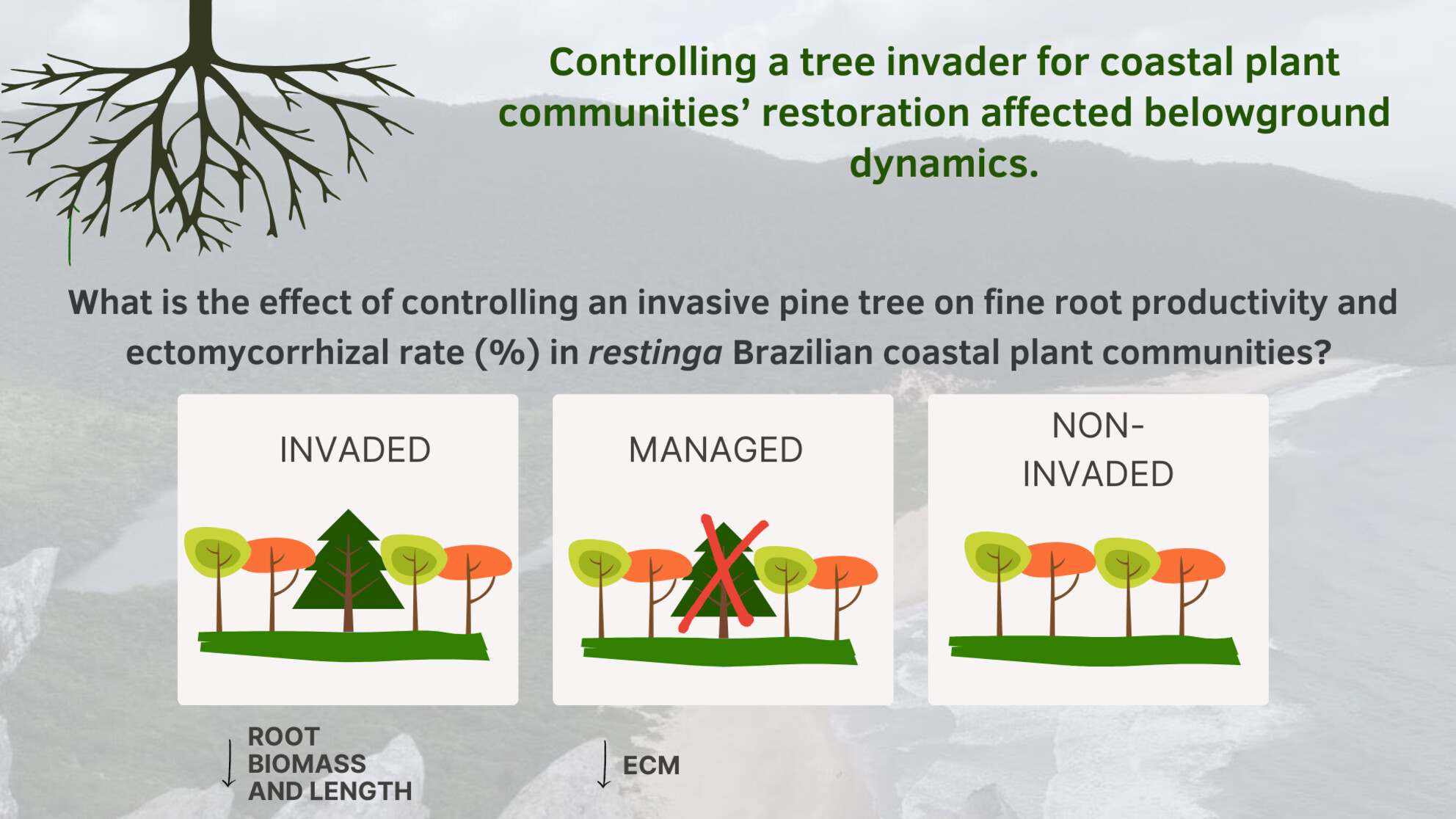
By showing novel data on fine root biomass, length and ECM rate when invasive non-native trees were controlled; our work fills a knowledge gap exploring how roots respond to invasion control after 6 years of interventions. The fact that we found fewer fine roots in the invaded area, and similar values in the managed and non-invaded areas suggest that the removal of pines was sufficient for the recovery of native vegetation.
Root dynamics play a role in natural regeneration when an invasive plant is controlled, and legacy effects should be considered in planning and monitoring restoration.
This is a Plain Language Summary discussing a recently-published article in Journal of Applied Ecology. Find the full article here.