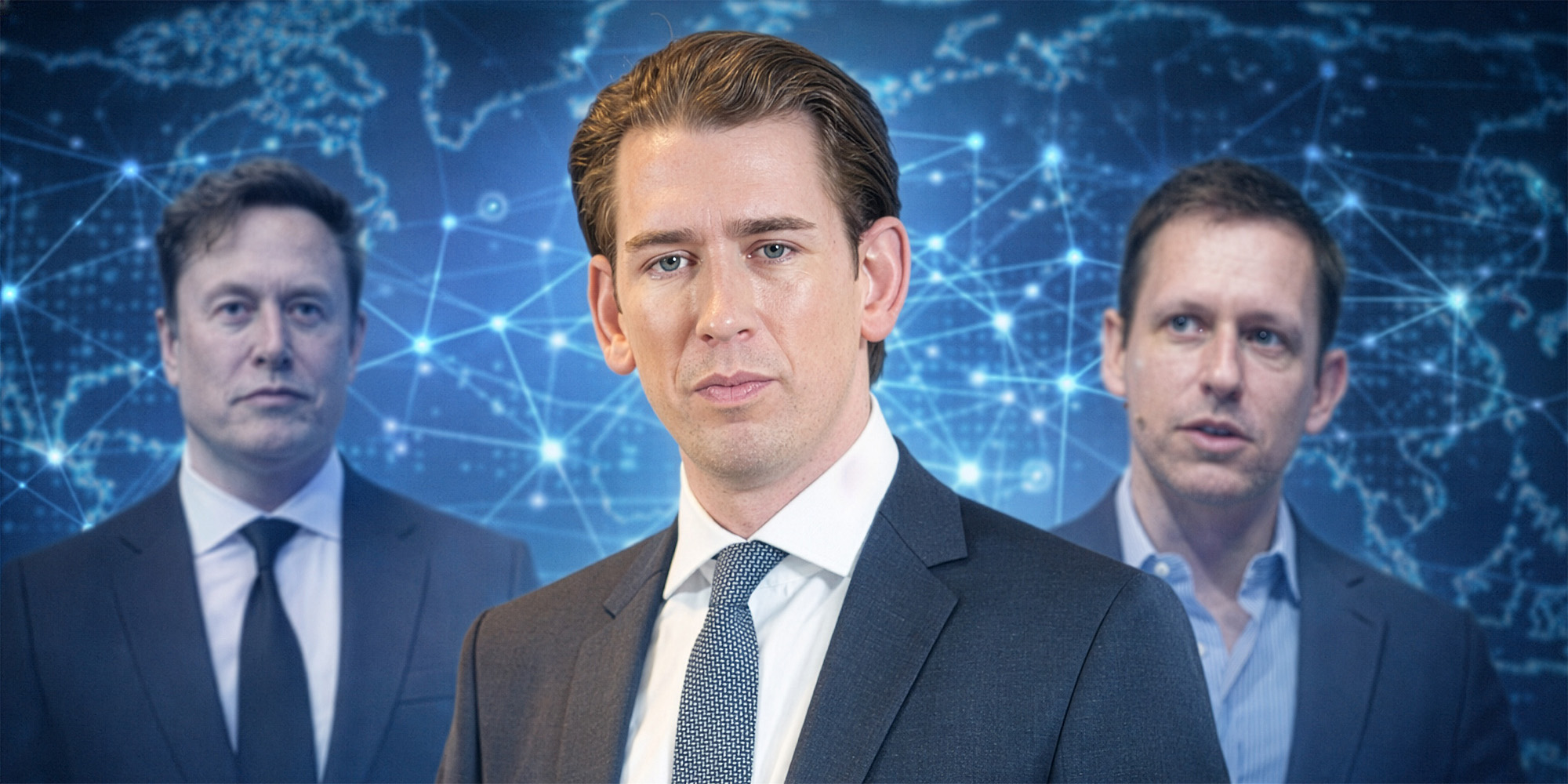
Tech billionaires Peter Thiel and Elon Musk are financing Donald Trump’s authoritarian political project—and in return, they receive lucrative government contracts. High-tech companies like Palantir, Anduril, or the Israeli NSO Group are taking over ever more responsibilities within the state’s security and surveillance apparatus. “Security policy,” meaning state surveillance, is increasingly outsourced to private firms, while democratic oversight is pushed aside. This model is not limited to the United States; a similar structure is emerging in Europe. One of its actors is former Austrian Chancellor Sebastian Kurz.
The U.S. tech industry has long played a central role in the state and the military-industrial complex. But Donald Trump’s return to the White House has brought this entanglement to a new level. Corporations such as Palantir, SpaceX, and Anduril now work closely with the military, intelligence agencies, and the civil administration. A new architecture of public-private power is emerging. Digital surveillance is no longer managed by public institutions. Instead, private high-tech corporations handle this task. The United States is at the forefront of this transformation.
This is no coincidence: parts of the tech elite have worked deliberately to build the Trump system. Entrepreneurs like Peter Thiel and Elon Musk were among his key supporters, contributing millions to finance his campaign. In return, they receive public contracts worth billions.
Peter Thiel’s Palantir becomes the operating system of the U.S. military
Economist Francesca Bria describes how Trump’s financial backers reap the rewards: their investment results in enormous government contracts. Palantir, for example, secured a ten-billion-dollar contract from the Pentagon. Its software effectively became the operating system for large segments of the U.S. military.
Anduril is developing autonomous weapons systems for the Department of Defense. Elon Musk’s private space and satellite ventures also play a crucial role. Today, they form critical infrastructure for military communications.
The tight alliance between tech corporations, financial capital, and the security apparatus has created a system in which political loyalty and public contracts come dangerously close together. Bria calls this web an “authoritarian high-tech complex.”
Authoritarian high-tech networks are emerging in Europe, Israel, and the Gulf states
This structure is not unique to the United States. Similar networks are taking shape in Europe. One example is Dream Security, a cybersecurity company with offices in Tel Aviv, Vienna, and Abu Dhabi. At its center stands former Austrian Chancellor Sebastian Kurz. After leaving politics, he became directly embedded in this authoritarian high-tech complex. He is a co-founder of Dream Security.
Sebastian Kurz: From chancellor to “security entrepreneur” at Dream Security
Sebastian Kurz shaped Austrian domestic politics for years. After stepping down, he joined Thiel Capital as a “Global Strategist.” Thiel Capital is the investment vehicle of Palantir co-founder Peter Thiel. This move placed Kurz inside a network of tech investors, financial capital, and right-authoritarian political forces. Bria describes this milieu as the “vanguard of a new authoritarian bloc of global power.”
Kurz later positioned himself as a co-founder of Dream Security, a rapidly growing company that markets itself as a “security firm.” Outwardly, Dream Security presents itself as an AI specialist for national cybersecurity. Yet it remains unclear what the company actually provides. Little is known about its clients.
Nevertheless, investors already value Dream Security at over one billion euros. According to its own statements, the company’s services are aimed exclusively at governments and operators of critical infrastructure. Dream Security claims it can protect entire networks of utilities, public authorities, and institutions. This puts the company squarely in the domains that Bria describes as the new foundations of state sovereignty: communication systems, data flows, and digital control infrastructures.

The Kurz–Dream team comes from the controversial NSO Group behind the Pegasus spyware
Alongside Kurz, Shalev Hulio is a co-founder and CEO of Dream Security. Hulio previously co-founded and long headed the NSO Group—the Israeli company that made global headlines with its Pegasus spyware.
Pegasus can covertly take over smartphones, activate microphones and cameras, read encrypted messages, and create detailed movement profiles. According to investigations by the international “Pegasus Project,” the software was used not only against alleged criminals or terrorism suspects but also against journalists, human rights defenders, lawyers, and opposition politicians—even against people connected to murdered Saudi journalist Jamal Khashoggi and members of the Catalan independence movement.
Several other Dream Security executives also come directly from NSO’s structures:
- Chief Legal Officer Ilan Grinshtain moved from the legal department of a major Israeli defense corporation to NSO, and from there to Dream Security.
- Head of HR Orit Azarzar previously oversaw global personnel operations at NSO.
- Head of Cyber AI Tal Fialkow worked for many years in data science and artificial intelligence for the Israeli government, followed by a senior role at NSO.
These connections show how state security tasks are being shifted into private high-tech companies, concentrating key levers of democratic oversight among a small number of wealthy actors. Critics describe Dream Security as a kind of NSO Group operating under a new name.
Capital flows, international networks, and right-wing politics
The authoritarian high-tech complex is backed primarily by venture capital. Funds like Founders Fund, 1789 Capital, or 8VC invest strategically in surveillance, defense, and security technologies. They promote political projects in which state power is outsourced to private corporations.
The investors behind Dream Security fit this pattern: Bain Capital Ventures, Tru Arrow Partners, and Tau Capital invest heavily in military, cybersecurity, and critical-infrastructure technologies. Additional investors hail from the Israeli tech sector, including Group 11, Aleph, and XT Venture Capital.
Kurz serves as a connective node in this network. His stint at Thiel Capital placed him alongside the very investors Bria describes as the intellectual and financial spearhead of an authoritarian tech project.

Expansion and possible IPO plans
While billion-dollar contracts for Palantir and others are already reshaping government digital infrastructure in Washington and London, Dream Security remains in a build-out phase. The company is valued at around one billion dollars and aims to expand its international footprint. It plans to open a U.S. office in addition to its bases in Tel Aviv, Abu Dhabi, and Vienna. During recent trips to New York, Kurz reportedly explored the opportunities and obstacles of a potential Wall Street IPO.
Such a move is considered realistic no earlier than one to two years from now, and the exact stock exchange remains undecided. Kurz owns roughly 15 percent of Dream. If the company succeeds in going public, his stake—based on today’s valuation—could be worth tens or even hundreds of millions. A successful IPO would further strengthen the former chancellor’s economic and political role within this international security and tech nexus.
More on Peter Thiel and the NSO Group
Peter Thiel
Peter Thiel is a German-American tech billionaire and investor. He is one of the largest political donors among the U.S. tech elite. Thiel became well known as a co-founder of PayPal and as a major financier of Palantir. Today, Palantir is one of the most important software providers for the U.S. military, intelligence agencies, and security authorities. For years, Thiel has openly promoted anti-democratic and right-libertarian positions. As early as 2009, he declared that freedom and democracy were no longer compatible in his view. Politically, Thiel supports authoritarian and right-populist projects. He has funded Donald Trump and several Republican hardliners. Through Thiel Capital and Founders Fund, he invests specifically in surveillance, defense, and security technologies. Critics consider him a key figure in the tightening nexus between the tech industry, the security apparatus, and political power.
NSO Group
Investigations by the international Pegasus Project revealed that Pegasus was used not only against criminals but also against journalists, human rights defenders, lawyers, and opposition politicians. As a result, NSO came under heavy global criticism. The United States placed the company on a sanctions list. Today, NSO is widely seen as a symbol of the commercialization of state surveillance technology.
The rights to the content remain with the original publisher.