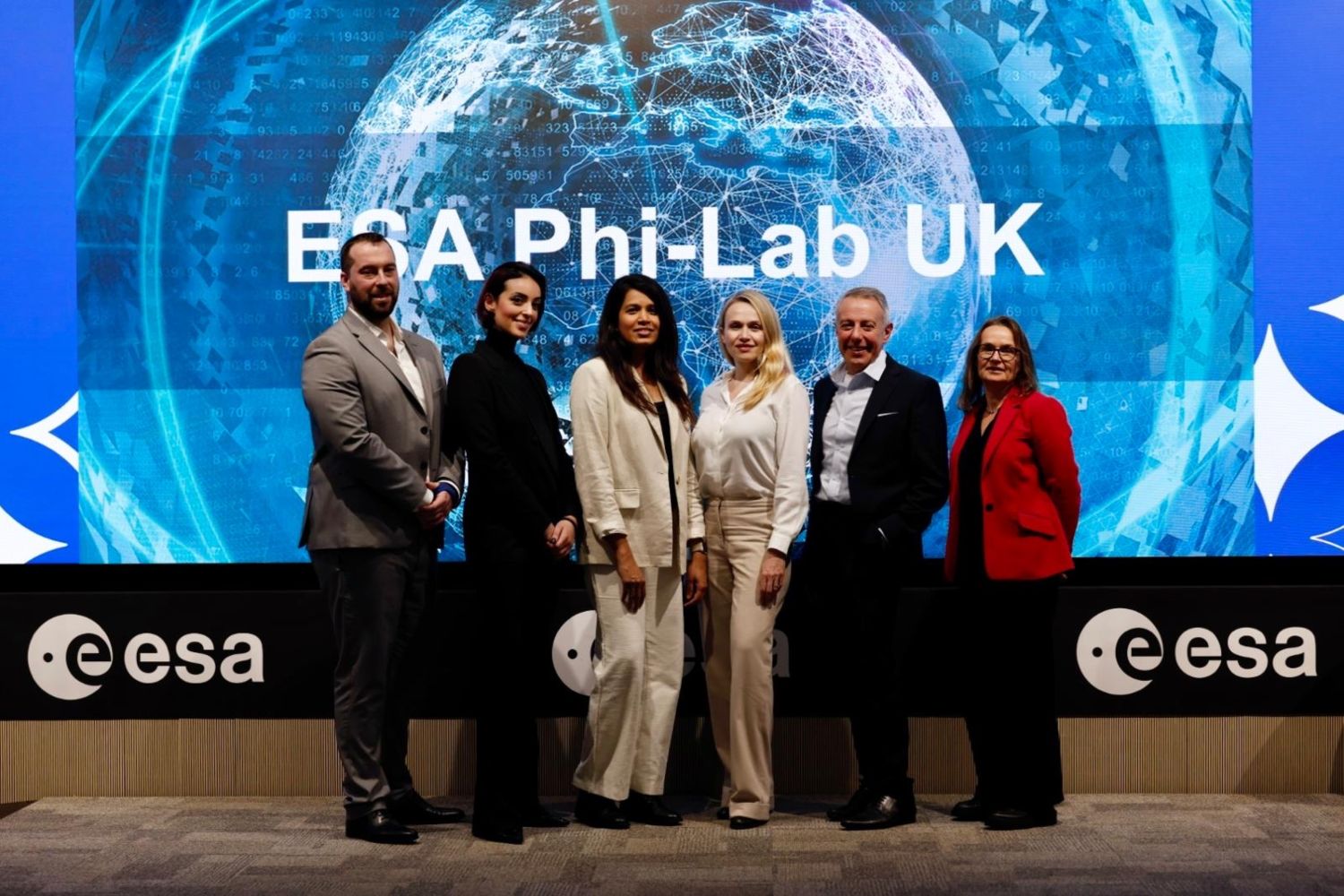
Deep Planet and Space DOTS have been selected as the first cohort of the newly established European Space Agency (ESA) Phi-Lab UK.
They received nearly £380,000 (€450,000) in seed funding for projects that use AI to address sustainable agriculture and space environmental challenges.
The announcement was made on 4 December 2025, at the Appleton Space Conference, a major annual conference hosted by the UK’s national space laboratory, RAL Space, operated by the Science and Technology Facilities Council (STFC).
ESA Phi-Lab UK
The ESA Phi-Lab UK, with focus on space-enabled sustainability technologies, is part of the ScaleUp Element of the newly launched ACCESS Programme from ESA.
The programme aims to accelerate commercialisation and competitiveness of the European space sector.
The hub is jointly funded by ESA, STFC and its partners, and UK Space Agency.
It is part of the ESA Phi-LabNET, a network of 10 ESA Phi-Labs across Europe with the mission of bringing research closer to commercialisation and bridging disruptive research and commercial needs.
Deep Planet
Deep Planet, a University of Oxford spin-out founded in 2018, has been awarded nearly £190,000 (€224,846) for SoilCarbonAI.
The project will use AI to predict soil organic carbon levels across regions where ground truth data is typically unavailable.
The geospatial AI company will develop a foundation model trained on massive-scale geospatial data.
This will enable farmers, agricultural supply chains and governments to drive sustainable land management and improve transparency in carbon offsetting processes.
Sustainable future
Sushma Shankar, Co-Founder and Chief Executive Officer (CEO) of Deep Planet said:
We are incredibly excited to have been selected as part of the inaugural cohort for the ESA Phi-Lab UK.
This is a fantastic recognition of Deep Planet’s scientific approach to leveraging geospatial AI for critical environmental monitoring, particularly in areas like regenerative agriculture.
We are looking forward to collaborating with our global field partners including National Trust, Alliance Wines and Synergy India Ventures, and ESA Phi-Lab UK to push the boundaries of AI and Earth Observation, thus accelerating the impact of space technology for a sustainable future.
Space DOTS
Space DOTS, a London-based startup, has been awarded nearly £190,000 (€225,000) for SEISMIC.
The project will build network of satellites that monitor conditions in space.
The company will integrate sensors into CubeSats and SmallSats to track radiation and space weather.
This data will help spacecraft better protect themselves and operate more independently, whether they’re orbiting close to Earth or traveling much farther out into space.
Both companies will receive additional support vouchers of up to €150,000 each to access technical, business and commercial expertise from Phi-Lab partners, including STFC, Amentum, and Cranfield University.
Important step
Bianca Cefalo, CEO and Founder of Space DOTS said:
We are honoured to join ESA Phi-Lab UK’s first cohort. SEISMIC is an important step toward treating the space environment as an operational data layer, not a background risk.
Working alongside ESA and the SWIMMR team is a major milestone for Space DOTS and a catalyst for Europe’s future resilience and autonomy in orbit.
Pioneering companies
Philip Thomas, Head of ScaleUp Programme Division, ESA said:
ESA Phi-Lab UK, within the ScaleUp Element of the ACCESS Programme, is designed to help pioneering companies turn space-enabled ideas into services that work in the real world.
By backing Deep Planet and Space DOTS, we are supporting solutions that protect our environment, enhance the robustness of space operations, and contribute to ESA’s long-term ambition for a more capable and resilient European space ecosystem.
Transformational innovation in space
Research projects hosted at the ESA Phi-Lab UK will benefit from access to STFC and consortium partners’ expertise and facilities.
The hub is designed to be a seedbed for transformational innovation in space, with projects selected for their innovation and commercialisation potential.
ESA Phi-Lab UK builds on STFC’s 15-year track record of delivering ESA Business Incubation Centre UK (ESA BIC UK), which has supported numerous companies, creating over 1,000 highly skilled jobs.
These companies have contributed £350 million cumulative direct UK economic impact (GVA), representing a more than 20-times return on investment for the UK government, and boast a 95% survival rate, well above the national average.
Both companies are also alumni of ESA BIC UK.
Space technology delivering benefits on Earth
Dr Paul Bate, CEO of the UK Space Agency:
These projects exemplify the innovation and entrepreneurial spirit thriving in our UK space sector.
By supporting this cutting-edge work, we’re not only advancing our capabilities in Earth observation and space situational awareness, but also demonstrating how space technology can deliver real benefits here on Earth.
The ESA Phi-Lab UK will help accelerate the commercialisation of transformative space technologies while supporting the UK’s ambitions for a sustainable and competitive space sector.
Catalysing development
Through UK universities, STFC funding has generated 39 spin-out companies between 2007 and 2022.
Research conducted in STFC’s National Laboratories has generated 22 spin-out companies between 2002 and 2022, attracting £98 million of third-party investment and creating 294 highly skilled jobs.
Recent advancements in AI, quantum sensing, robotics, and earth observation instrumentation are creating new opportunities for entrepreneurs in space-enabled sustainability technology.
The ESA Phi-Lab UK aims to catalyse development in these areas while strengthening space clusters across the UK.
The ESA Phi-Lab UK is aligned to several goals identified in the National Space Strategy, including being geographically dispersed across the country and promoting technology advancements relating to space safety, security and sustainability.
Sharing world-class expertise and facilities
Antonio Costa, Programme Manager for ESA Phi-Lab UK said:
From monitoring radiation and space weather to supporting our farming and agriculture networks, STFC is proud to share our world-class expertise and facilities in the space sector to explore solutions to critical problems.
The ESA-Phi Lab UK will enable innovators to turn cutting-edge science into practical solutions which address the problems society faces today.
By supporting these businesses, we’re helping to enhance the safety and reliability of space operations, create high-quality jobs, strengthen the UK economy, and advance our capabilities in this rapidly growing sector.