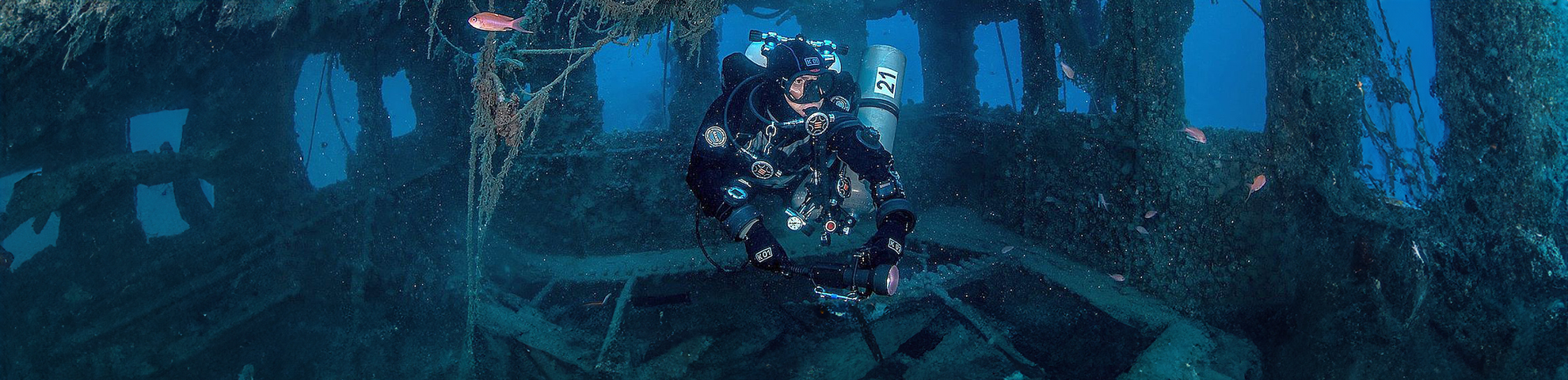
Forty metres beneath the sea off north-western Italy lies one of the country’s best-preserved World War II shipwrecks. The Equa, an Italian cannon-equipped submarine chaser, sank with no casualties after being accidentally rammed by a German ship in 1944.
The vessel now hosts rich marine fauna that attracts divers and fishers. The site is a key focus of research for scientists working to preserve maritime heritage across Europe in the light of growing pollution and environmental change.
In August 2023, divers discovered worrying developments that could accelerate the ship’s erosion.
They detected a 2 °C increase in seabed temperature relative to historical records for the site, significantly above seasonal norms. There was also a strange, ascending current that stirred sand and silt from the seabed, preventing divers from completing 3D filming of the wreck.
“These findings highlighted the need for further sampling and scientific analysis to confirm climate-driven impacts on wreck deterioration,” said Dr Angelos Amditis, research and development director at the Institute of Communication and Computer Systems (ICCS) in Athens, Greece.
Amditis leads THETIDA, an EU-funded collaboration running until October 2026. Its researchers focus on protecting Europe’s underwater and coastal cultural heritage from climate-related threats such as rising temperatures, pollution, acidification and changing currents.
Push for protection
The Equa wreck is one of seven pilot sites being studied in THETIDA, spanning coastal and underwater locations in the Mediterranean and northern Europe. These include two shipwreck sites in Italy, a shipwreck off Cyprus, a World War II aircraft wreck off Portugal, the castle of Mykonos in Greece, Lake IJssel in the Netherlands, and a coal cableway station in Svalbard, Norway.
According to Dr Panagiotis Michalis, senior researcher at the I-SENSE Group of ICCS and project manager of THETIDA, all pilot sites show that climate-driven hazards such as coastal erosion or extreme weather events are accelerating.
“
Wrecks and submerged settlements are degrading faster than we can study or stabilise them.
“By combining in situ sensing, satellite observations and advanced underwater monitoring technologies, our aim is to generate early warning indicators and provide heritage managers with practical tools to act before irreversible damage occurs,” he said.
Experts point out there are still significant gaps when it comes to finding ways to preserve maritime heritage and guidelines for doing so.
“Many sites are undocumented, and wrecks and submerged settlements are degrading faster than we can study or stabilise them,” said Amditis.
He did, however, acknowledge the importance of UNESCO’s 2001 Convention on the Protection of Underwater Cultural Heritage and the EU’s commitment to placing cultural heritage high on its agenda.
Lakeside heritage
The Dutch study relates to the IJssel, a large freshwater lake separated from the sea by a dyke completed in 1932. Bordering it are the remains of former towns, villages, dykes, sluices, pumping stations and mills. The focus has been on Gemaal de Poel, an old pumping station.
“The authorities didn’t know what to do with the building and were talking about possibly demolishing it,” said Dr Deniz Ikiz, a heritage and climate change researcher at Eindhoven University of Technology, part of the THETIDA team.
“But the citizens felt it was part of their heritage and still felt attached to it.”
Much of the focus has been on the citizen science element. In workshops and meetings, referred to as Living Labs, local residents, authorities, students and heritage practitioners have been able to voice their views, which are then incorporated into conservation strategies.
“It’s important to understand the priorities of different communities via these Living Labs, identifying what they value and see as their heritage,” said Ikiz.
THETIDA has also been developing a crowdsourcing app allowing people to visualise 3D models of the seven sites and share observations.
“This case study has set an example for how decisions can be made,” said Ikiz.
Arctic role
The Norwegian pilot site provides a different perspective on coastal heritage, raising questions about whether certain objects can and should be preserved at all.
It concerns the Hiorthhamn coal cableway station in the Svalbard archipelago, north of the Arctic Circle.
“
It’s about re-evaluating what we consider meaningful heritage.
This region has experienced one of the fastest rates of climate change in the world, leading to dramatic loss of sea ice and permafrost.
The old mining site contains a unique collection of buildings, cable car masts, the remains of a locomotive and railway tracks. Researchers have predicted that, without mitigation, the site is likely to disappear within 10 to 20 years.
Dr Paloma Guzman, a researcher on heritage policy and management at the Norwegian Institute for Cultural Heritage Research in Oslo, explained that the Svalbard community’s connection to coal mining is rapidly changing, being replaced by tourism, services and research. Norway’s last coal mine in the region closed this June, and many miners have left.
Defining principles
The Svalbard study raises some complex issues. Here, heritage is defined almost entirely through chronological criteria: everything built before 1946 is automatically protected, regardless of its condition, meaning or relevance.
However, as the landscape rapidly changes due to permafrost thaw and coastal erosion, this rigid definition makes conservation nearly impossible in practice.
“What matters is not whether a community is still present,” said Guzman. “It’s about re-evaluating what we consider meaningful heritage, so that conservation remains grounded in shared histories and values and not a blanket obligation rooted only in age.”
A site at risk of collapsing might also endanger the environment, particularly when industrial debris is exposed by erosion.
In this context, recognising diverse types of value – historical, environmental, social and scientific – becomes essential to making realistic decisions about what to stabilise or document, and how to manage inevitable losses.
Guzman’s work is not just about defining coastal and maritime heritage, it is about showing how current protection policies must be updated to reflect climate change and the practical limits it creates.
Across submerged wrecks, inland waterways and Arctic settlements, THETIDA’s work reflects a broader challenge facing Europe: climate change is reshaping our coastlines and heritage landscapes faster than institutions can respond.
Yet local communities continue to assert what heritage means to them. By listening to these voices, the researchers are building something more durable than any single wreck: a framework for thinking about what we choose to save, and why it matters.
Research in this article was funded by the EU’s Horizon Programme. The views of the interviewees don’t necessarily reflect those of the European Commission. If you liked this article, please consider sharing it on social media.