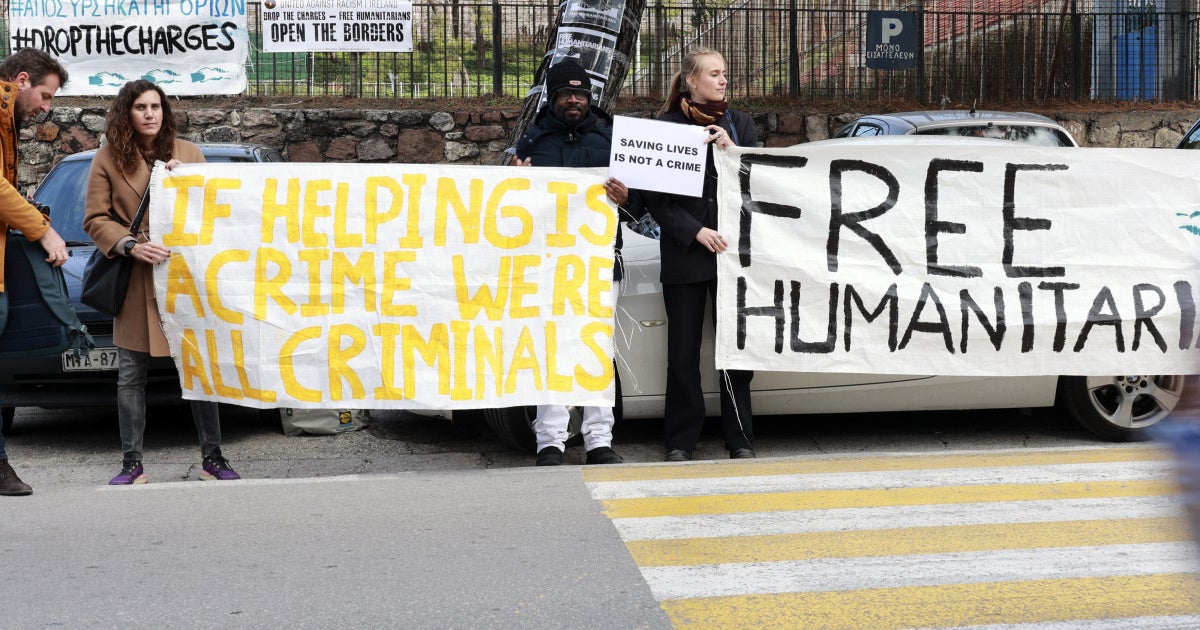
Two dozen humanitarian workers face trial on the Greek island of Lesbos this week on baseless felony charges that carry 20 years in prison. Prosecutors have hounded the humanitarians for seven years for saving lives at sea, while the European Parliament has called this “the largest case of criminalization of solidarity in Europe.”
In 2015, up to 10,000 asylum seekers and migrants were making the perilous sea crossing from Turkey to Lesbos per week. At least 805 people, including 271 children, died or disappeared in the Aegean Sea that year. Emergency Rescue Center International (ERCI), a small nonprofit, started search and rescue operations to support overwhelmed local authorities.
But in 2018, two of ERCI’s foreign volunteers were jailed for 107 days based on a flawed police report depicting rescue work as smuggling and espionage, despite a Hellenic Coast Guard official’s statement to the police that the group had regularly notified him when migrants’ boats were coming. Two Greeks were also later placed in pretrial detention. Human Rights Watch found the charges perversely misrepresent ERCI as a crime ring.
Instead of dropping the case, Greek prosecutors charged 24 people and blundered past basic due process requirements. Some defendants were reportedly never served. Other indictments were missing pages and written in Greek, which some foreign defendants did not understand.
In 2021, the prosecution filed misdemeanor charges against all the defendants but in the wrong court. One of the foreign volunteers jailed in 2018 was barred from re-entering Greece for her own trial. When the misdemeanor case was finally heard, it collapsed and all charges were dismissed.
The prosecution is now pursuing three felony charges. But after a years-long investigation found no new evidence, the case depends on deeply-flawed logic: saving lives at sea is mischaracterized as migrant smuggling (felony 1), so the search-and-rescue group is a criminal organization (felony 2), and therefore, the group’s legitimate fundraising is money laundering (felony 3).
The case is an acute example of a disturbing trend in Europe of criminalizing solidarity with people on the move. The United Nations Special Rapporteur on Human Rights Defenders noted that rights defenders and humanitarian workers in Greece face the misuse of criminal law against them to a “shocking degree.”
An acquittal of the defendants will be the only just end to a perverse prosecution that should never have started.